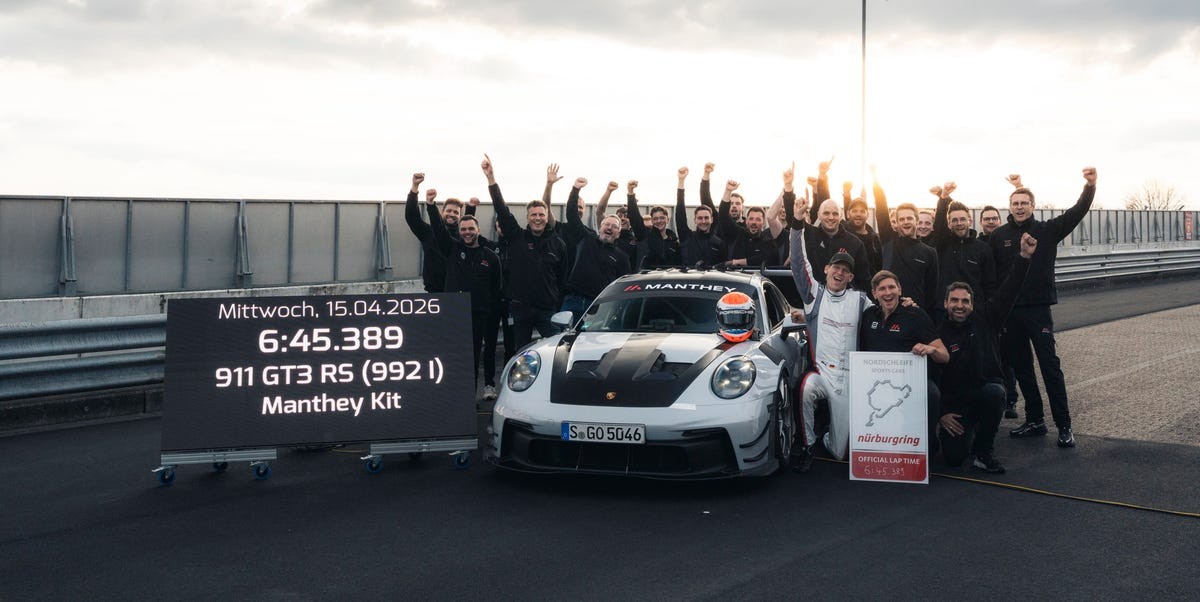
The Nürburgring Nordschleife has long served as the ultimate proving ground for automotive engineering. It is a grueling, 13-mile gauntlet that separates true performance machines from mere marketing claims. Recently, two of the industry’s biggest players—Porsche and Ford—clashed for dominance on this legendary circuit, though the results come with significant technical caveats.
Porsche’s Precision: The Manthey-Enhanced GT3 RS
Porsche returned to the “Green Hell” with a highly specialized version of its 992.1-generation 911 GT3 RS. To push the limits of the platform, the automaker equipped the car with the Manthey Racing kit, a package designed to optimize handling and aerodynamics for track use.
Driven by Porsche’s veteran development driver, Jörg Bergmeister, the Manthey-equipped GT3 RS clocked an impressive time of 6:45.389.
This wasn’t just a minor improvement; it was a significant leap forward. The lap time was nearly four seconds faster than the standard production GT3 RS. According to Porsche, the aerodynamic and suspension upgrades in the Manthey kit provide a level of stability that allows for unprecedented performance. Specifically, the car can now maintain full throttle through the technical Pflanzgarten II to Schwalbenschwanz section—a feat previously considered nearly impossible for a road-legal vehicle.
The Ford Counterstrike: Mustang GTD Competition
Porsche’s celebration was cut short when Ford announced its own breakthrough on the same day. Ford revealed that its Mustang GTD Competition had conquered the circuit with a blistering time of 6:40.835.
By the raw numbers, Ford has taken the lead, outperforming the Porsche by nearly five seconds. This move signals Ford’s aggressive intent to position the Mustang brand as a legitimate contender in the highest echelons of global performance engineering.
A Matter of Classification: Why the Numbers Aren’t Everything
While the headline reads as a victory for Ford, a closer look at the official classifications reveals a more nuanced reality. In the world of Nürburgring timing, how a car is categorized determines how its time is perceived:
- The Porsche 911 GT3 RS (Manthey Kit): Classified as a Sports Car. This implies it is a production-based vehicle that closely mirrors what a customer could theoretically purchase.
- The Mustang GTD Competition: Classified as a Prototype or Pre-Production model. This category often allows for more extreme modifications and specialized components that may not be present in a final consumer version.
This distinction is vital. While Ford has set a faster time, the Porsche is competing in a category that represents a more “real-world” production standard, whereas the Mustang is currently operating under the rules of a developmental prototype.
The Purpose of the Performance Race
It is important to note that these record-breaking laps are largely performative. Very few drivers—let alone the general public—will ever drive at these limits on public roads. However, these feats serve a crucial purpose in the automotive industry: brand prestige.
Automakers use these “halo” achievements to demonstrate technological prowess. A faster lap time at the Nürburgring acts as a high-speed advertisement, signaling to enthusiasts that the engineering DNA of the brand is at the cutting edge of physics and control.
Even when the numbers are disputed by classification, the competition between Porsche and Ford drives rapid innovation, pushing the boundaries of what is possible for both racing prototypes and high-performance road cars.
In summary, while Ford has posted a faster time with the Mustang GTD Competition, the distinction between a production-based Sports Car and a Prototype means the true battle for supremacy between these two icons is far from over.