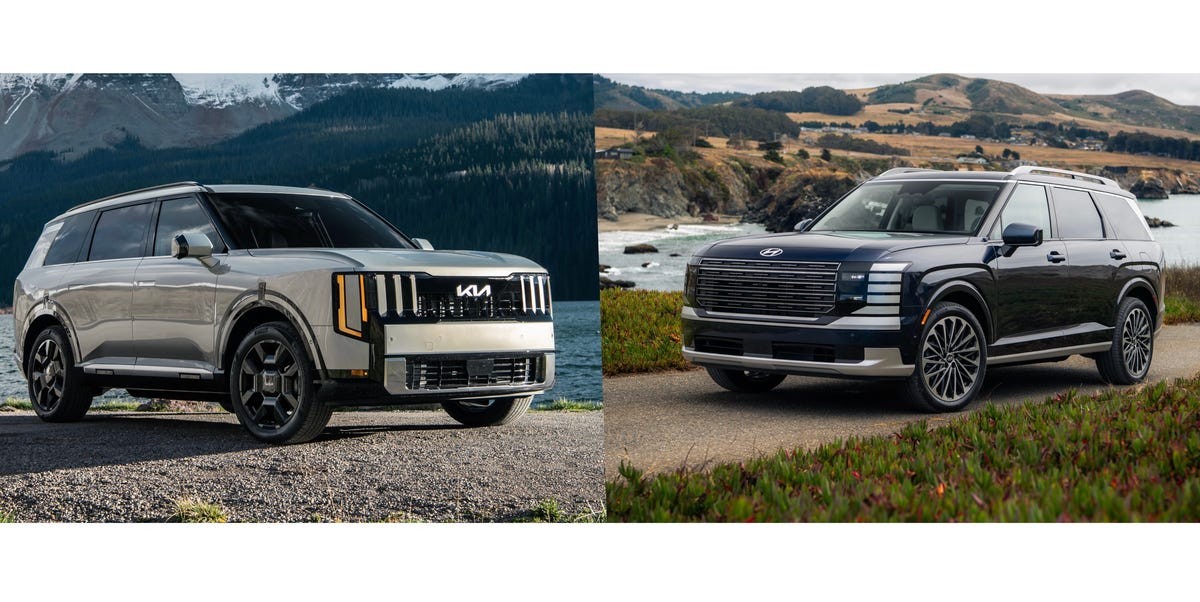
The Hyundai Palisade and Kia Telluride are two of the most competitive mid-size, three-row SUVs on the market. Both vehicles share engineering and platform foundations, yet offer distinct styling and trim options. With the release of updated second-generation models – the Palisade for 2026 and the Telluride for 2027 – now is a good time to explore their key differences. This comparison breaks down size, pricing, performance, and features to help you decide which SUV best fits your needs.
Size and Space: Minimal Differences
Both SUVs are nearly identical in dimensions. They share the same 116.9-inch wheelbase, with overall length varying slightly: the Telluride measures 199.2 inches, while the Palisade ranges from 199.2 to 200.4 inches depending on the trim. Width differences are also negligible.
Both offer standard three-row seating, accommodating eight passengers in lower trims (with a three-person bench in the middle row) and seven in higher trims (with captain’s chairs).
Cargo space is where the Telluride edges out the Palisade: 22 cubic feet with all seats up versus 19 cubic feet. With the rearmost seats folded, the Telluride offers 49 cubic feet to the Palisade’s 46. Max cargo capacity is 89 cubic feet for the Telluride and 87 for the Palisade. These differences, though small, could matter if you frequently need maximum space.
Powertrains: Hybrid and Non-Hybrid Options
Both Hyundai and Kia now offer a shared hybrid powertrain. This consists of a turbocharged 2.5-liter four-cylinder engine paired with a six-speed automatic transmission and two electric motors, producing 329 horsepower and standard all-wheel drive. This hybrid setup offers the highest output for both models.
However, the base engines diverge. The Palisade retains a 3.5-liter naturally aspirated V-6 (287 horsepower), while the Telluride switched to a 2.5-liter turbocharged four-cylinder (274 horsepower). The Kia’s turbo-four provides more torque (311 lb-ft) than the Palisade’s V-6 (260 lb-ft), which could improve acceleration and towing performance. Both engines offer front- or all-wheel drive options.
Towing capacity is 5,000 pounds for both, but hybrid models tow slightly less: 4,500 pounds for the Telluride Hybrid and 4,000 pounds for the Palisade Hybrid. Both offer tow mode for optimized transmission programming.
Fuel Economy: Hybrid Advantage
The hybrid versions of both SUVs deliver the best fuel economy. The Palisade Hybrid achieves up to 33 mpg city and 35 mpg highway (FWD Blue trim). Other FWD models manage 31/32 mpg, while AWD versions get 29/30 mpg. EPA figures for the Telluride Hybrid are not yet available, but are expected to be comparable.
Non-hybrid versions offer similar mileage, with AWD models both rated at 18/24 mpg city/highway. FWD versions see a slight advantage for the Telluride at 20/26 mpg compared to the Palisade’s 19/25 mpg. Off-road trims (Palisade XRT Pro and Telluride X-Pro) have lower ratings.
Off-Road Capabilities: XRT Pro and X-Pro Trims
Both brands offer off-road-focused trims (Palisade XRT Pro and Telluride X-Pro) with 18-inch all-terrain tires, an electronic limited-slip differential, off-road drive modes, and under-vehicle cameras (up to 6 mph). The Telluride X-Pro has slightly more ground clearance (9.1 inches) than the Palisade XRT Pro (8.4 inches), but neither includes skid plates. These models prioritize mild off-road capability over serious rock crawling.
Pricing and Trim Levels: Wide Range of Options
The Palisade offers seven trim levels (SE, SEL, SEL Convenience, SEL Premium, Limited, XRT Pro, and Calligraphy), priced from $41,035 to $56,160. The Palisade Hybrid has seven variants as well, skipping the base SE and XRT Pro trims, ranging from $45,760 to $58,380.
The Telluride offers a staggering ten trim levels (LX, S, EX, X-Line EX, SX, X-Line SX, X-Pro SX, SXP, X-Line SXP, and X-Pro SXP), priced from $40,735 to $58,335. The Telluride Hybrid has five variants (EX, SX, X-Line SX, SX-Prestige, and X-Line SX Prestige), with pricing expected to be comparable to non-hybrid trims.
Pricing between the two brands is very competitive, making trim choice and styling the main differentiating factors.
Conclusion
The Hyundai Palisade and Kia Telluride remain very close competitors. The main differences lie in powertrain options (V-6 vs. turbo-four) and styling preferences. Both offer spacious interiors, comparable fuel economy, and similar feature sets. Ultimately, the choice between these two will likely come down to personal preference, brand loyalty, and available inventory.