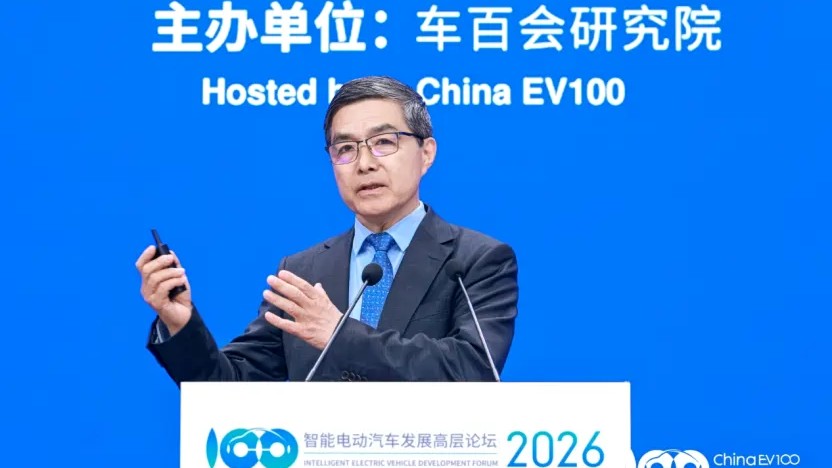
At the recent Intelligent Electric Vehicle Development Forum in Beijing, Professor Ouyang Minggao of Tsinghua University delivered a decisive forecast for the future of transportation. His central thesis is clear: the era of plug-in hybrids (PHEVs) and extended-range electric vehicles (EREVs) is already in decline.
According to Ouyang, the technological roadmap of China is moving toward a future where pure electric vehicles (BEVs) hold an absolute monopoly on the market.
The Efficiency Argument: Why Hybrids are Losing Ground
The shift away from hybrid models is not merely a matter of consumer preference, but of fundamental physics and energy efficiency. Ouyang argues that pure electric drives represent the most effective way to utilize “green electricity.”
When compared to other emerging technologies, the efficiency gap is massive:
– Pure Electric vs. Hydrogen: BEVs are twice as efficient.
– Pure Electric vs. Synthetic Fuels: BEVs are four times more efficient than internal combustion engines running on synthetic fuels.
This energy advantage suggests that as the power grid becomes greener, the “bridge” technologies like hybrids will eventually become obsolete, replaced by the direct efficiency of battery electric systems.
A Roadmap to 2040: Market Share Projections
Ouyang provided a specific timeline for how the Chinese automotive landscape will transform. This transition is characterized by a steady increase in the ratio of pure electric vehicles relative to other plug-in models.
| Year | New Energy Vehicle (NEV) Market Share | BEV to Plug-in Ratio |
|---|---|---|
| 2030 | > 70% | 7:3 |
| 2035 | > 80% | 8:2 |
| 2040 | > 80% | 9:1 |
By 2040, Ouyang predicts that pure electric drive will have “completely ended the route debate,” allowing the Chinese automotive industry to complete its transition from being a massive producer to a global technological leader.
The Solid-State Reality Check
While the industry is currently captivated by the promise of solid-state batteries, Ouyang issued a note of caution. He warned against treating this technology as a marketing gimmick, noting that significant scientific hurdles remain—specifically regarding chemical, mechanical, and thermal stability at the interfaces of the battery components.
While he expects solid-state batteries with an energy density of 300 Wh/kg to emerge by late 2030, he emphasized that the industry must proceed with scientific rigor rather than hype. Despite these challenges, China is making rapid strides, already accounting for 44% of new solid-state battery patent applications globally.
Safety and the Evolution of Battery Tech
The transition to electric mobility has been marked by a constant evolution in safety standards. Ouyang traced this progress through three key eras:
1. 2014: Safety concerns led to the suspension of ternary batteries in buses.
2. 2020: BYD’s “Blade Battery” (LFP) proved that lithium iron phosphate could be successfully used in passenger vehicles.
3. The Future: A shift toward mandatory standards requiring batteries to be both non-combustible and non-explosive.
“China currently lacks an authoritative safety ranking system,” Ouyang noted, suggesting that more standardized, lifecycle-based safety metrics are needed to match international benchmarks.
Scaling the Industry: Commercial Vehicles and the Grid
The transformation extends beyond passenger cars. Ouyang projects that new energy commercial vehicles (such as trucks) will see market shares exceeding 70% by 2040.
Crucially, the “greenness” of these vehicles will depend on the power grid. As China increases its renewable energy capacity, the electricity used to charge these vehicles is expected to be 65–70% renewable by 2035, ensuring that the transition is truly sustainable.
Conclusion
The transition toward pure electric vehicles in China is being driven by a combination of superior energy efficiency, aggressive patent development, and a massive scaling of renewable energy. If these projections hold, the automotive industry is moving toward a singular, electrified standard that will leave hybrid technologies behind by the next decade.