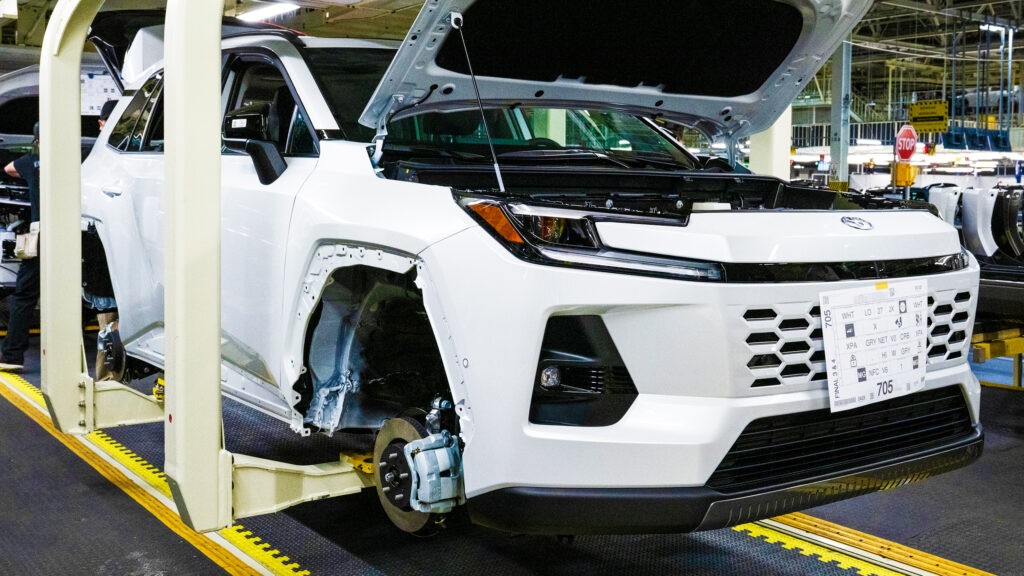
Toyota is betting heavily on its Canadian manufacturing base for the next-generation RAV4, despite looming questions about the future of North American trade agreements. The automaker is rapidly scaling up production at its Woodstock and Cambridge, Ontario plants, with the new hybrid-only RAV4 model set to hit dealerships soon.
Hybrid-Only Shift and Investment
For the first time, the RAV4 sold in North America will exclusively be offered as a hybrid vehicle. This strategic shift is backed by a CA$1.1 billion (approximately $810 million USD) investment into Toyota Motor Manufacturing Canada (TMMC), the largest automotive manufacturer in the country. The upgrades include dedicated areas for building battery packs, crucial for the new hybrid models. Production is slated to reach full capacity by March, with output already increasing over the past five weeks.
North American Manufacturing Strategy
While Canadian plants will lead the charge, the 2026 RAV4 will also be assembled at Toyota’s Lexington, Kentucky facility. The Kentucky plant will handle increased production, shifting from previous ICE models to hybrids. All plug-in hybrid versions of the latest RAV4 will continue to be built in Japan. This division of labor highlights Toyota’s complex, cross-border supply chain strategy.
USMCA Uncertainty and Trade Risks
The company’s confidence in its supply chain faces a significant test: the future of the United States-Mexico-Canada Agreement (USMCA). Recent comments from US President Donald Trump calling the agreement “irrelevant” just as it’s due for renegotiation create uncertainty. Toyota Canada Director of Corporate and External Affairs, Scott MacKenzie, acknowledges the volatility, stating that the company is “watching the situation closely.”
The risk is real. If USMCA collapses, the viability of Canadian production could be threatened, potentially leading to further price increases for consumers. Toyota has already absorbed some tariff costs, but long-term trade disruptions could force them to pass those expenses on.
Long-Term Gamble
Toyota is making a bold, long-term investment in North American production despite the instability. The company believes an integrated, trilateral approach is the most effective way forward, even as the political landscape remains unpredictable.
Toyota’s strategy underscores a larger trend: automakers are navigating a turbulent geopolitical environment while simultaneously transitioning to electric and hybrid vehicles. The success of this gamble depends on whether trade policies will allow the supply chain to remain intact.
In the end, Toyota’s future is tied to the fate of North American trade, making the next few years critical for its long-term automotive strategy.