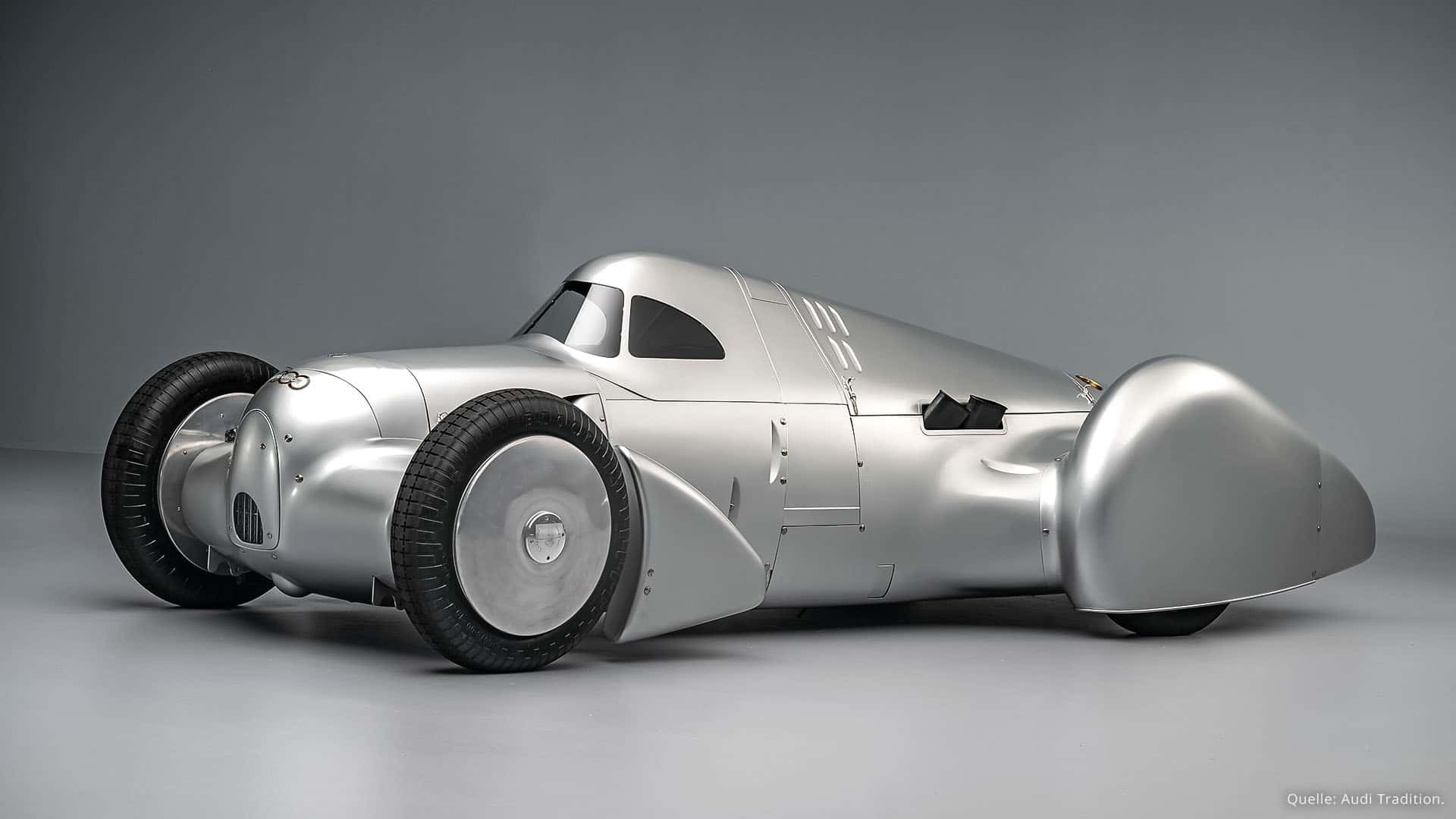
Audi has resurrected one of the most iconic machines in automotive history: the Auto Union Lucca, a 16-cylinder record-breaker from the 1930s. After a three-year restoration project by specialists Crosthwaite & Gardiner, the vehicle is set to make its debut in Lucca, Italy, in spring 2026—the very city where it shattered speed records nearly a century ago.
This restoration is more than a nostalgic exercise; it bridges the gap between modern Audi and its pre-war racing heritage. The original Auto Union cars, developed before the formal establishment of Formula 1, are widely considered the spiritual forebears of modern single-seater racing. Their return highlights a critical era in engineering where aerodynamics and raw power first converged to redefine the limits of physics.
A Record Forged in Speed and Strategy
The original Lucca car achieved its fame on February 15, 1935. Driven by Hans Stuck, known as the “King of the Mountains,” the streamlined racer tore through a measured mile on the autostrada near Lucca. The results were staggering:
- Average Speed: 199 mph (320.267 km/h) over a flying-start mile.
- Peak Speed: 203.2 mph (326.975 km/h).
At the time, this made the Auto Union the fastest road-racing car in the world. The achievement was not just a triumph of horsepower but of organizational agility. In an era where speed was treated as a substitute religion, the rivalry between Germany’s state-subsidized giants—Daimler-Benz and Auto Union (the “Star” vs. the “Rings”)—drove rapid innovation. When Daimler-Benz posted 196.4 mph in late 1934, Auto Union’s engineering team in Zwickau responded with unprecedented speed, moving from drafting boards to a finished prototype in weeks.
Engineering Ahead of Its Time
The Lucca was a technological marvel, particularly for its use of aerodynamics. For the first time in European race-car construction, data from the wind tunnel at the German Research Institute for Aviation in Berlin-Adlershof was directly applied to body design.
The result was a sculptural masterpiece:
* Finely finished light-alloy panels.
* Fully covered wheels to reduce drag.
* A fin-like tail that remains visually striking today.
Underneath the sleek exterior lay an early version of a 16-cylinder engine, producing 343 hp from a 5.0-liter displacement. However, technology alone did not secure the record. Timo Witt, head of Audi Tradition’s historic vehicle collection, emphasizes that flexibility was key. The team’s ability to adapt to changing weather and logistical challenges on short notice was as crucial as the car’s engineering.
The Odyssey to Lucca
The path to the record was fraught with challenges, involving a desperate race against bad weather across Europe.
- Initial Tests: The car was completed in December 1934 and tested at Berlin’s AVUS circuit.
- Hungary: The team initially planned to set the record near Gyón, Hungary, where Mercedes had set class records. However, deteriorating weather and a blown exhaust during test runs on February 5, 1935, forced a halt.
- Italy: The team moved south to Italy. After finding snow-covered roads near Milan, they settled on a stretch between Pescia and Altopascio near Lucca. This section was ideal: 3.1 miles (5 km) of almost arrow-straight, well-graded asphalt with excellent grip.
On February 14, 1935, the team conducted final configuration tests, tweaking radiator openings and wheel covers. The following morning, Hans Stuck took the wheel and delivered the historic performance.
Authenticity Meets Practicality
The 2026 reconstruction balances historical accuracy with modern practicality. While the exterior is a faithful replica of the 1935 record car, internal modifications ensure the vehicle can survive demonstration runs.
- Engine: The rebuild uses a 6.0-liter Type C engine. Externally identical to the original, this swap simplifies parts supply within the Silver Arrow family.
- Cooling: Enhanced cooling systems and ventilation, some of which were originally developed for the May 1935 AVUS race, prevent thermal stress during modern operation.
- Driving Dynamics: The cockpit remains true to the era, featuring a huge steering wheel and an unsynchronized five-speed gearbox that demands precise throttle blips for clean shifts. It is a machine that “demands serious work” from its driver.
“Of course, we recreated the car as authentically as possible, but at the same time, issues like the vehicle’s longevity and implementing the project as efficiently as possible were important to us.”
— Timo Witt, Head of Audi Tradition
A New Chapter for a Historical Icon
The original Lucca car’s story did not end with the record. It appeared at the Berlin Auto Show in February 1935, promoting Auto Union as the holder of world records, and later competed in the AVUS race in May 1935, where it faced reliability issues against lighter Grand Prix cars.
Today, the restored Lucca serves as a tangible link to that pioneering era. After its premiere in Italy, the car is scheduled to appear at the Goodwood Festival of Speed from July 9 to 12, 2026. There, it will offer spectators a rare opportunity to hear the thunder of its 16-cylinder engine and witness the aerodynamic elegance that once defined the pinnacle of speed.
The return of the Auto Union Lucca underscores a enduring truth in motorsport: while technology evolves, the pursuit of speed and the engineering ingenuity required to achieve it remain the heart of the sport.