Chery’s newest electric vehicle brand, operating under the name iCaur internationally, made a significant splash at the Beijing Auto Show. While the brand—pronounced “iCar” despite the silent ‘u’ in its overseas branding—is still finding its footing outside China, its debut lineup signals a clear strategy: combining rugged, boxy aesthetics with cutting-edge electric architecture.
The highlight of the show was the Robox, a futuristic off-road concept that hints at where the brand is heading. Alongside it, iCaur displayed production-ready models like the large V27 SUV and the sporty V23, both of which are expected to enter the Australian market by early 2027.
The Robox Concept: “Robot” Meets “Box”
The Robox is not just a name; it’s a portmanteau of “robot” and “box,” designed to evoke a sense of modular, high-tech utility. It has no connection to the video game Roblox, a common misconception given the similar spelling.
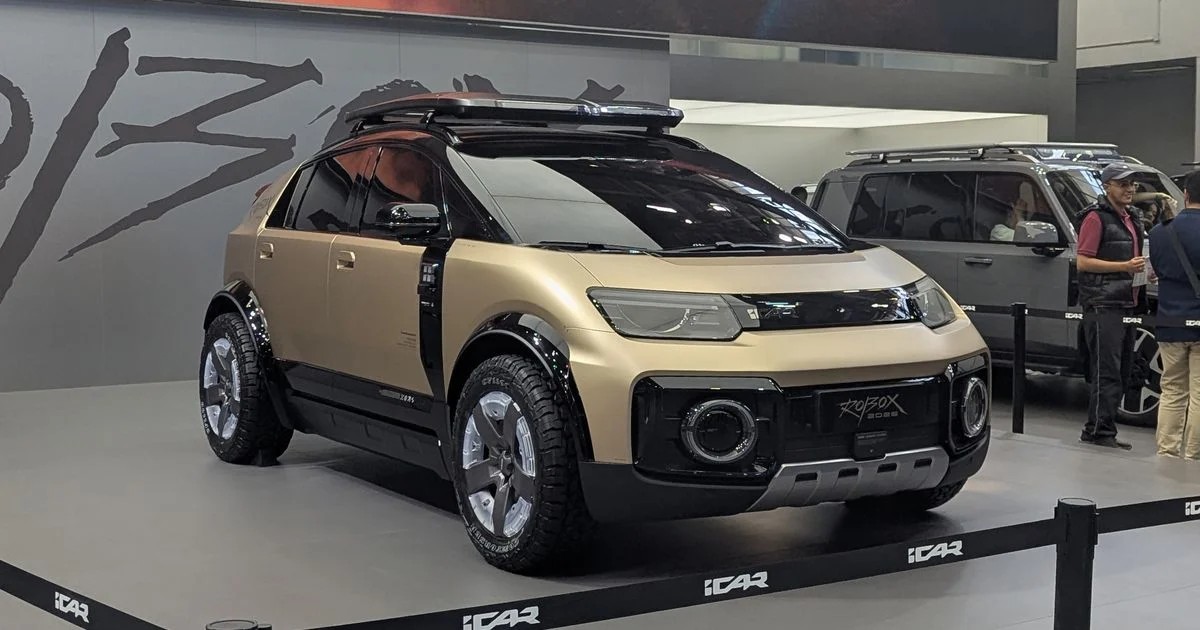
Unlike iCaur’s current lineup, which consists of upright, strictly utilitarian SUVs, the Robox introduces a “future-classic” design philosophy. It blends timeless proportions with a streamlined “OneBox” silhouette, creating a vehicle that is both rugged and aerodynamic.
Key Design Features:
– Aerodynamic Profile: A short front overhang and a continuous arc from the windscreen to the tailgate reduce drag.
– Off-Road Credibility: Flared wheel arches, roof racks, and chunky Comforser CF1100 all-terrain tires on 19-inch wheels.
– Distinctive Lighting: Round lighting elements in the front bumper sit below conventional headlights, while rear lights are discreetly integrated into the bumper.
The interior remains a mystery, as no images were released and the cabin was not visible at the show.
Under the Skin: The i-SWIFT 3.0 Platform
While the Robox is a concept, it provides a window into the technology powering iCaur’s future vehicles. Reports indicate the concept is built on the new i-SWIFT 3.0 platform, which boasts several industry-leading specifications:
- 1000V Electrical Architecture: Enables ultra-fast charging speeds.
- Axial Flux Motors: More efficient and compact than traditional radial flux motors.
- Battery Flexibility: Compatible with both lithium-ion and emerging solid-state batteries.
- Autonomous Driving: Supports Level 3 and Level 4 self-driving capabilities.
This platform suggests that iCaur aims to compete not just on price, but on technological sophistication, targeting consumers who demand rapid charging and advanced driver-assistance systems.
Production Models: The V27 and V23
While the Robox draws attention, the production models on display offer concrete details for potential buyers, particularly in Australia.
The V27: A LandCruiser Challenger?
The V27 is a large SUV sized similarly to the Toyota LandCruiser 300 Series. It is an Extended-Range Electric Vehicle (EREV), meaning it uses a petrol engine solely to generate electricity for the battery and motors, rather than driving the wheels directly.
Specifications:
– Dimensions: 5045mm (L) x 1976mm (W) x 1894mm (H) with a 2900mm wheelbase.
– Powertrain: 1.5-litre turbocharged four-cylinder petrol generator paired with a Lithium Iron Phosphate (LFP) battery.
– Performance: Dual-motor AWD system delivers 335kW and 505Nm of torque.
– Range: Claimed 150km electric-only range (with a 34kWh battery) and a total combined range of up to 995km (NEDC).
– Acceleration: 0-100km/h in 5.9 seconds.
The V23 “White Glint”: Sporty Compact SUV
Also displayed was the V23 White Glint, a monochromatic, sportier variant of the smaller V23 SUV. Its design features graphics reminiscent of Polestar, signaling a move toward a more premium, performance-oriented aesthetic.
Specifications:
– Battery: 80.16kWh capacity.
– Powertrain: Dual-motor electric setup producing 335kW and 490Nm.
– Acceleration: 0-100km/h in 4.5 seconds, matching the performance of the high-end “Cyber Edition” already sold in China.
Why This Matters for Global Markets
The arrival of iCaur in markets like Australia by 2027 represents a significant shift in the competitive landscape. By offering vehicles that combine long-range EREV technology with high-performance EV dynamics, Chery is targeting customers who suffer from range anxiety but desire electric performance.
The Robox concept, with its focus on autonomous readiness and modular design, suggests that iCaur is not just copying existing trends but attempting to define a new segment of “smart” off-roaders. As the brand expands, the question remains: Can iCaur’s technological promises translate into reliable, consumer-friendly products that can challenge established giants like Toyota and BYD?
In summary, iCaur’s debut at the Beijing Auto Show marks a pivotal moment for Chery’s global ambitions, blending rugged utility with next-generation electric technology in a bid to capture a growing segment of the international SUV market.