In the history of American automotive performance, few “what if” scenarios are as tantalizing—or as frustrating—as the story of the Chevrolet 427 Z11. It is a tale of a superior machine sidelined by corporate politics, a decision that arguably handed the keys to the muscle car era to Chrysler’s Mopar division.
The Great Engine Ban of 1963
In 1963, General Motors issued a sweeping corporate mandate that fundamentally altered the landscape of the American street. To prevent internal competition between its own brands, GM banned its divisions from racing and developing high-displacement engines for intermediate cars. Specifically, no mid-sized vehicle could exceed 400 cubic inches of displacement.
The only exception was the Chevrolet Corvette. While this rule was intended to maintain order within the GM family, it had an unintended consequence: it left a massive performance vacuum in the mid-size market. While Chevrolet and Pontiac were restricted to 396ci and 400ci engines, Ford began introducing larger 428ci and 429ci V-8s, and Chrysler unleashed the legendary 426 Hemi.
The Z11: A Performance Unicorn
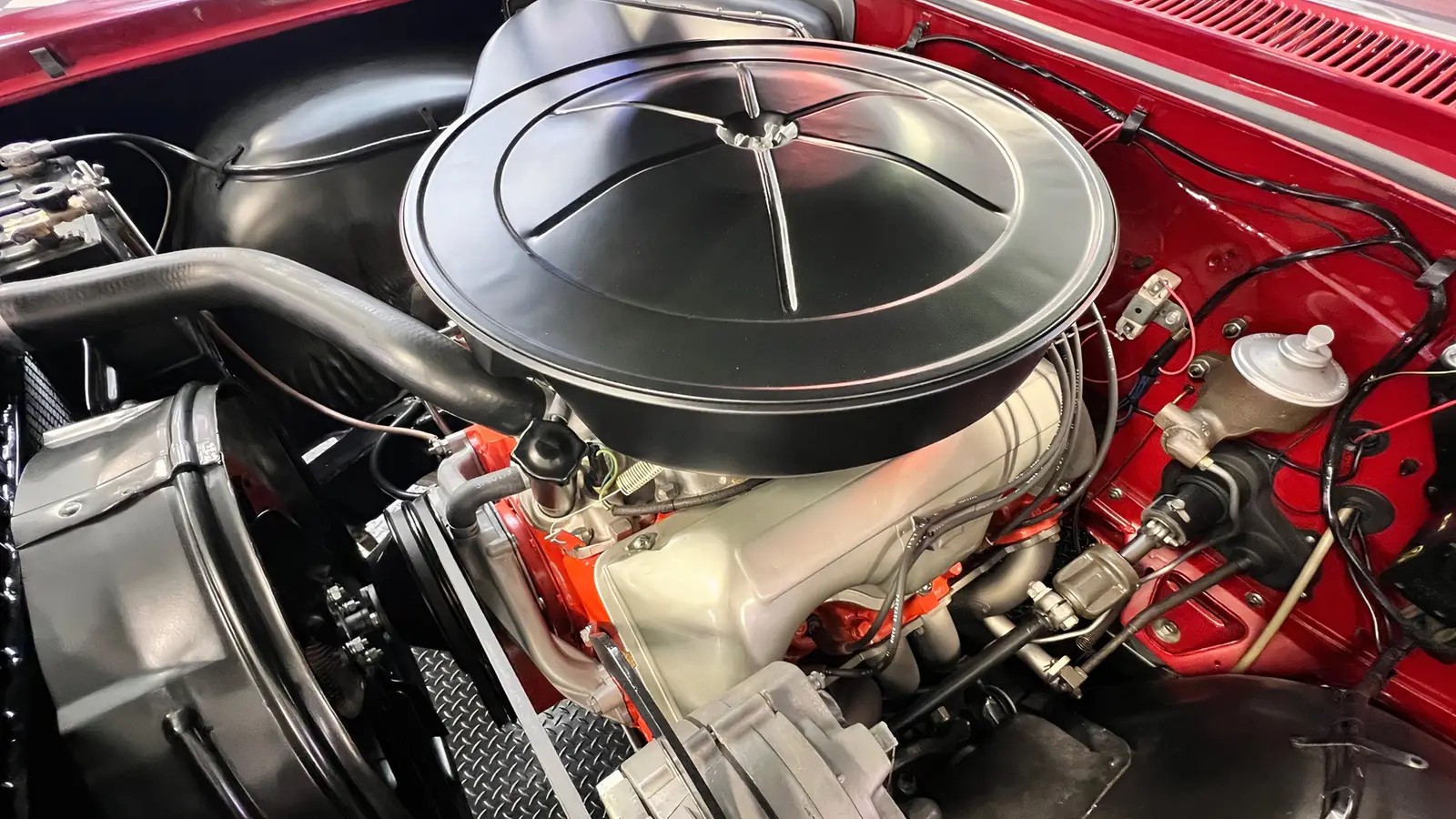
Unbekside this ban, Chevrolet had already engineered a masterpiece. The 427ci Z11 V-8 was a monster of engineering. Based on the W-series 409, the Z11 featured a longer stroke and a high-rise, two-piece aluminum intake manifold designed to feed two Carter AFB carburetors.
The specs were staggering for the era:
– Horsepower: 430 hp
– Torque: 575 lb-ft
– Performance: A 10.8-second quarter-mile and 0–60 mph in 4.3 seconds.
Because of the displacement ban, Chevrolet couldn’t put this engine in the newly released Camaro or the Chevelle. Instead, they relegated it to a highly specialized, factory-built drag car: the 1963 Impala Z11.
To maximize performance, the Z11 Impala was a “dieted” machine. It featured lightweight aluminum body panels and stripped-out interiors, weighing roughly 500 pounds less than a standard Impala. It was a purpose-built weapon for the drag strip, not a cruiser for the suburbs.
Scarcity and Value
The Z11 remains one of the most elusive prizes in the collector world. While historical records are famously inconsistent—some sources claim 57 units were built, while official GM documentation lists only 50—the rarity is undisputed.
In 1963, the Z11 package cost a premium of $1,240 over a base Impala, totaling roughly $4,000. Adjusted for inflation, that is approximately $41,149 today. However, in the current collector market, these “unicorn” cars command prices far exceeding that, often reaching hundreds of thousands of dollars due to their extreme scarcity and racing pedigree.
The Ripple Effect: Yenko and the Corvette Exception
The GM engine ban created a secondary market of “mad geniuses” who found ways to circumvent the rules. Most notably, racer and dealer Don Yenko utilized the GM Central Office Production Order (COPO) system to bypass restrictions, stuffing massive 427ci engines into Camaros, Chevelles, and even compact Novas. These “Yenko Super Cars” became legends in their own right, born directly from the limitations imposed by GM headquarters.
Furthermore, the decision to protect the Corvette at all costs—even when it meant stifling other innovations like a V-8 powered Pontiac Fiero in the 1980s—highlights a recurring theme in GM’s history: corporate protectionism often came at the expense of engineering potential.
Conclusion
The Chevrolet 427 Z11 was a powerhouse that arrived at the wrong time and in the wrong package. Had GM allowed its mid-size divisions to utilize such high-displacement, high-carburetion engines, the “muscle car wars” might have looked very different, potentially cementing Chevrolet’s dominance over the era.
The Z11 stands as a reminder that in the automotive world, sometimes the greatest obstacle to performance isn’t engineering—it’s the boardroom.