


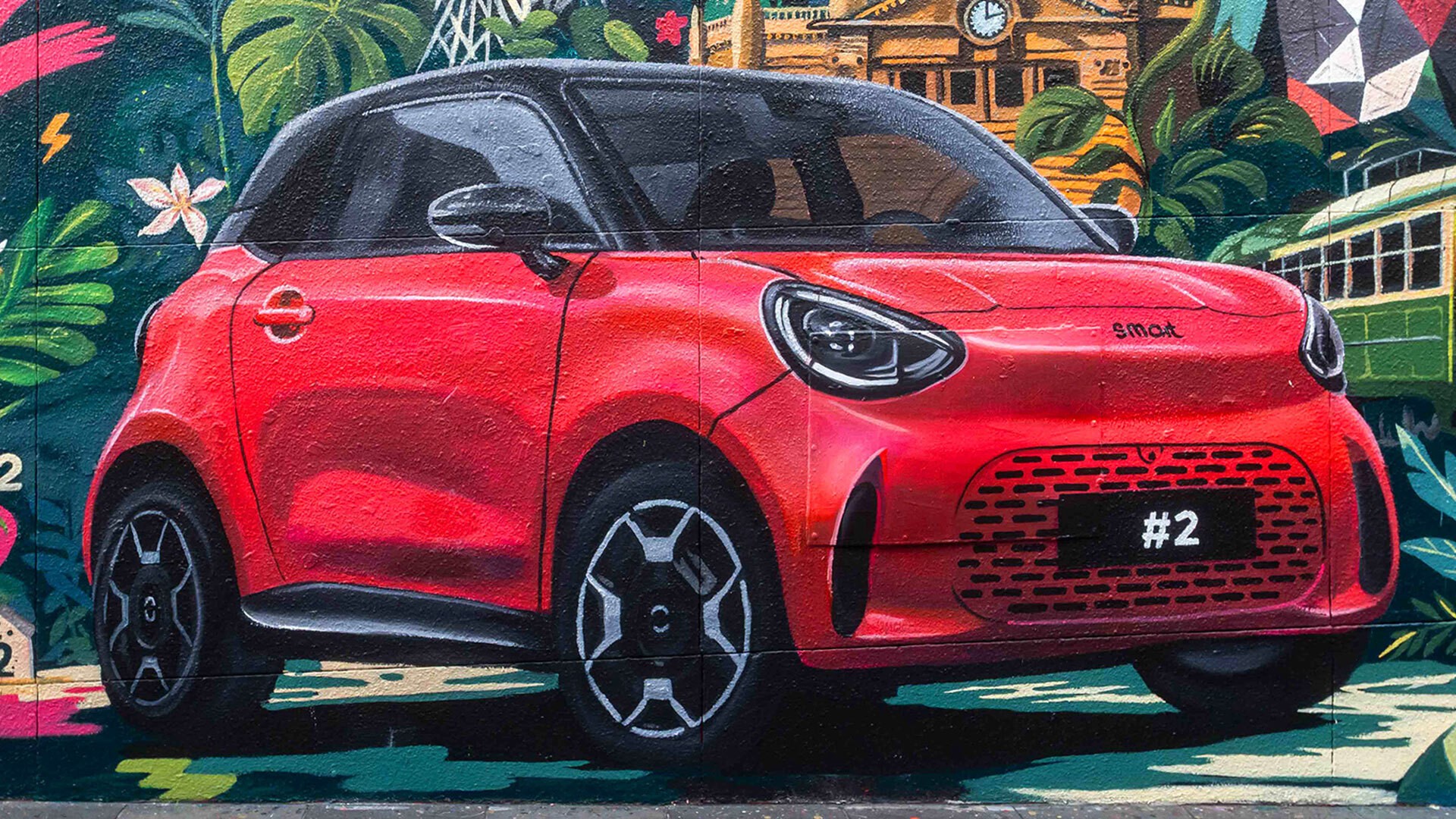
The streets of Berlin, Buenos Aires, and Hong Kong look a lot weirder than usual. That’s because Smart dropped literal number #2 murals across major global cities. It looks like an accident. It’s actually a teaser.
The German brand is hinting at the successor to its iconic two-seater. And unlike the awkward jokes of old, these street art pieces actually show us what the production car looks like.
A Refined Shark Nose and Practical Touches
The street art reveals a production model that respects its concept predecessor but adds some real-world necessities. The most obvious change? A ventilated grille. The sharp shark-nose front end got a light tweak to fit. The hood pushed back, giving the car a slightly different stance.
Then there’s the lighting. The concept had flashy, complex lights. The production version swaps them for vertical air curtains. Less gimmick. More function.
Side profiles are curvaceous. Rounded fenders dominate the view. You can see aerodynamically optimized wheels now. An optional contrasting black roof suggests a two-tone option is on the table. Door handles finally made it to the design, looking like proper mechanical parts rather than digital abstractions. There’s even a subtle hint of the Toyota iQ in the packaging.
The Rear and Dimensions Matter
Smart kept the rear under wraps in the official teasers. But zooming in on a planning sheet hidden in the mural details reveals the truth. Circular taillights are coming. A pronounced spoiler sits high up.
The liftgate looks more conventional. It features a mid-mounted license plate recess—a huge relief for practicality. The black bumper ditches a digital display for what appears tobe a standard reflector. Less screen, more safety.
Size-wise, the numbers tell a specific story. The new #2 measures 109.9 inches long. That’s 2,792 mm. It sits 3.8 inches longer than the second-generation ForTwo it replaces. Yet, the turning circle shrinks to a tight 22.8 feet. How does that geometry work? The wheelbase optimization likely plays a role, but the result is a car that feels longer yet tighter in cities.
Electric Compact Architecture and Range
Under the metal lies the Electric Compact Architecture. It’s a platform built for this specific class of urban EV. The battery pack is roughly 35.7 kWh. Range sits at around 186 miles. That’s approximately 300 km for metric users.
When you need juice fast, DC fast charging handles the heavy lifting. The system takes the battery from 10 to 0 percent charge in under 20 minutes. That’s enough time for a quick coffee run and a significant range boost.
Art, Engineering, and The Name
The murals weren’t just slapped on by a marketing team. They were a joint effort. The Mercedes-Benz design team worked with local artists like Martín Ron and Georgia Laurie. Zhu Bin contributed in Asia. Parents Parents handled the group efforts.
The collaboration isn’t accidental. It’s literal. Smart stands for Swatch, Mercedes, Art. The name itself is a tripartite contract. Swatch brought the timing and mass market appeal. Mercedes provided engineering and luxury. Art brings the cultural weight.
We are left with a clearer picture of what’s coming. The #2 is smaller than you think, electric enough for daily use, and dressed up as a canvas. Why the delay? The platform costs money. The rebranding took longer. Now, the dots connect.
The car will land in cities where parking is a nightmare and space is a premium. It won’t save the world. But it might save your commute. What happens when the concept meets the curb? That remains to be seen.


