


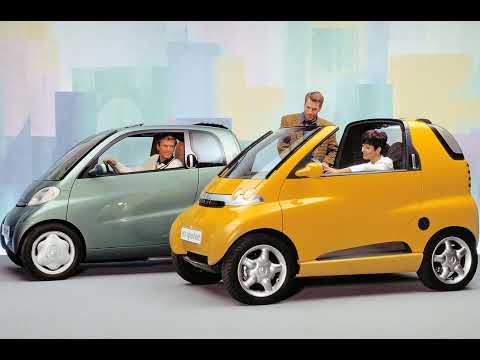
After a period of expanding into larger electric SUVs, the Smart brand is pivoting back to its original identity. The company is developing a new two-seat city car, a move that returns the brand to the very concept that defined its existence three decades ago: the compact, urban specialist.
The Legacy of the “Swatchmobile”
The DNA of the modern Smart car can be traced back to the early 1990s and the vision of Nicolas Hayek. A man famous for revitalizing the Swiss watch industry through the Swatch brand, Hayek applied similar principles of simplification and automation to the automotive world.
In 1990, Hayek proposed a concept known as the “Swatchmobile.” His vision was radical for its time:
– Compact Utility: A small electric vehicle designed to carry two people and minimal luggage.
– Affordability: A target price of roughly £3,570 (approximately £8,280 in today’s value).
– Engineering Shift: Hayek famously insisted on employing electrical engineers rather than traditional automotive engineers, aiming to treat the car more like a consumer electronic device than a heavy machine.
The Challenge of Early Innovation
While Hayek’s ambition was high, the timing proved difficult. In the early 90s, the industry was in a race to move electric vehicles (EVs) from science fiction to reality. Major players like General Motors, Volkswagen, and BMW were all exploring the potential of electrification.
However, the “Swatchmobile” faced a fundamental hurdle that many EV pioneers still grapple with today: battery technology. By the time testing began in early 1993, the project had already faced significant delays. The limitations of contemporary battery science meant that the car could not meet the promised range or price points, ultimately pushing the launch back to 1997.
Why This Matters Today
The return to a two-seat configuration is more than just a nostalgic nod; it is a strategic correction. Smart’s recent foray into larger electric SUVs attempted to capture a broader market, but it strayed from the “niche” identity that made the brand a global icon.
This shift highlights a broader trend in the automotive industry: as the market becomes saturated with large, heavy electric crossovers, there is a growing realization that urban mobility requires specialized, efficient, and ultra-compact solutions.
Smart is attempting to reclaim its original value proposition: providing a highly efficient, specialized tool for the modern city dweller.
Conclusion
By returning to its two-seat roots, Smart is attempting to recapture the unique market position it held at its inception. The brand is betting that, in an increasingly crowded EV landscape, there is still a significant demand for the small, specialized city car that first put them on the map.


