Harley Earl didn’t just design cars. He invented the very idea that a car could be a fashion statement.
Born in Los Angeles in 1893, Earl was already carving wooden race cars as a kid before he ever touched a steering wheel. By the late 1920s, his reputation for sculpting bodies out of wood and metal had reached the ears of Alfred P. Sloan, the chairman of General Motors. Sloan saw something Detroit was missing: artistry. He offered Earl a job. The offer was simple. Lead the styling of every GM car line.
Earl said yes. He moved to Detroit. And in doing so, he changed the automotive industry forever.
For 31 years, Earl held the reins. GM didn’t just lead the market; it defined it. But how did one man so thoroughly shift the paradigm? It wasn’t just about making things look pretty. It was about structure, psychology, and technology. Here is how Harley Earl built the modern automotive aesthetic, one innovation at a time.
The Birth of the Styling Studio
Before Earl arrived, engineering ruled Detroit. Mechanicals were king. Beauty was an afterthought, often bolted on by designers with little technical understanding. It was a disjointed era where a car’s hood might scream speed while its fenders whispered economy.
Earl saw the mess. He created a new division within GM called the Art and Colour Section. He later renamed it simply “Styling.” This wasn’t a side gig. It was a core department.
The impact was immediate. Competitors scrambled to copy the model. Suddenly, appearance mattered as much as horsepower. A car’s soul wasn’t just under the hood anymore. It was on the surface.
The Clay Revolution
Earl didn’t start this with a pencil. He started with clay.
Long before 3D rendering software, Earl was pushing his hands into malleable earth. He realized that two-dimensional sketches were limiting. You couldn’t judge the flow of a line or the weight of a form on paper. Clay allowed designers to see the car in three dimensions. It sped up the process. It made iteration cheap.
This tactile approach became the industry standard. If you want to know how car designers work today, look no further than Earl’s clay modeling roots. It transformed design from a static drawing exercise into a sculpting process.
The Dream Car and the Y-Job
Earl also invented the concept of the “dream car.”
In 1938, he unveiled the Buick Y-Job. It wasn’t meant for sale. It wasn’t meant for production. It was a statement. A one-off vehicle built to tease the public with what could be.
These concept cars served two purposes. First, they whetted the appetite of the car-hungry public. Second, they acted as market research. If the crowd went wild for the Y-Job’s hidden headlights, GM knew to put them on the next production model.
The dream car wasn’t just fantasy. It was a forecasting tool disguised as a sculpture.
Visionary Glass: The Wraparound Windshield
By the early 1950s, Earl was pushing boundaries again. The 1951 LeSabre concept car featured a windshield that didn’t stop at the pillars. The glass curved sharply around to meet the A-pillars themselves.
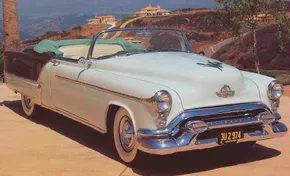
It was futuristic. It offered a panoramic view that made drivers feel immersed in the road. Production versions landed on the 1953 Cadillac Eldorado and Oldsmobile Fiesta. Within a few years, wraparound windshields were standard on almost every American car.
Piling on the Chrome (And When to Stop)
If you look at a 1958 Cadillac, you’re looking at Harley Earl’s obsession with chrome.
Earl knew that trim could add visual pizazz. But he also knew that “more” could eventually become “too much.” By the late 1950s, GM designers had piled on the brightwork until the cars looked like gaudy chariots. It was excessive. It was loud.
Detroit eventually reined it in. But for a brief moment, chrome was the ultimate flex.
The Dagmars and the Lightning’s Shadow
Design cues often come from unexpected places. For Earl, it was the Lockheed P-38 Lightning fighter plane. Specifically, its twin-boom tail.
He translated that aviation motif into the 1948 Cadillac. It featured ornamental appendages that would come to be known as tailfins. The trend exploded. By 1959, the fins on Cadillac models were skyrocketing toward the heavens. They would subside in the mid-60s, but for a decade, they were the symbol of American excess.
And then there were the Dagmars.
Named after a popular TV personality of the era, these were bullet-shaped bumper guards. They debuted on the 1951 LeSabre. They became standard on 1950s Cadillacs. They were bold. They were aggressive. They were pure Earl.
The Corvette: Born from a Race Track
The story of the Corvette is where Earl’s personal passion meets business strategy.
In September 1951, Earl took his personal LeSabre concept car to a race at Watkins Glen in New York. He drove over 45,000 miles in that show car. At the track, he watched enthusiasts cheer for imported sports cars like Jaguars and Porsches.
He realized something. Americans loved sports cars. But there was no affordable domestic option.
So, he built one. The Chevrolet Corvette debuted at the New York Motorama in January 1953. It was sleek. It was fast. It was American.
Structuring the Hierarchy
Earl’s genius wasn’t just aesthetic. It was strategic.
Alfred Sloan had already established a price hierarchy for GM brands. Chevrolet at the bottom. Cadillac at the top. But Earl gave that hierarchy visual language.
He designed a progression. A Chevrolet looked practical. A Pontiac looked youthful. An Oldsmobile looked innovative. A Buick looked refined. A Cadillac looked powerful.
Consumers were encouraged to aspire to the next rung. The design signaled status before the engine even started.
Integrated Body Design
Before Earl, cars were assemblies of disparate parts. Hood here. Fenders there. Separate grilles. It looked hodgepodge.
Earl visualized the car as a single, cohesive entity. He designed components to harmonize with the whole. The hood flowed into the fenders. The fenders flowed into the doors. Everything belonged.
This integrated body design became the baseline for all modern automotive styling.
The Legacy
Harley Earl died in 1969, but his fingerprints are on nearly every car you see. He turned vehicle design into a discipline. He proved that style could drive sales. He gave us the dream car, the styling studio, and the American sports car.
He also gave us the tailfins. And the chrome. Which, looking back, feels like a lot of chrome.
But the question remains. In an era of EVs and aerodynamic efficiency, does the “soul” of design still matter? Or have we traded Earl’s artistry for pure function?
The answer might be hiding in the next concept car you see.
The Vision That Came Too Early (But Not Too Early)
Harley Earl didn’t just want cars to look fast. He wanted them to see.
In 1956, the Buick Centurion concept car didn’t have traditional mirrors. At least, not the kind you’d expect. Earl swapped the glass for a functional television camera. It captured the road behind the vehicle and transmitted the live feed to a small monitor embedded in the dashboard.
It was science fiction on wheels. And it worked.
Most of us think backup cameras are a modern necessity, something that became standard on SUVs and luxury sedans in the early 2000s. We treat them as compliance tools for parking. But Earl was pushing the boundary of rear visibility nearly fifty years earlier. He wasn’t just adding a gimmick. He was reimagining how a driver interacts with the space behind them.
The technology was rudimentary by today’s standards. The screen was tiny. The image likely washed out in low light. But the core concept was identical to what you use to parallel park your crossover today.
Why Safety Was About More Than Steel
People often associate Harley Earl with chrome and tailfins. They remember the art deco curves and the two-tone paint jobs. That’s the visible legacy. The invisible legacy is safety, though he didn’t use the word much in those terms.
He cared about what happened to the human body when metal met impact.
Consider the dashboard of the pre-1950s era. Hard plastic. Exposed knobs. Sharp edges. In a collision, those weren’t just parts of the car. They were projectiles. Earl introduced padded dashboards. He recessed the knobs so they wouldn’t snag a limb during an emergency stop.
These weren’t afterthoughts. They were design decisions driven by a desire to protect the occupant, not just the machine.
The Color Revolution
Before Earl, black was the default. It was practical. It hid dirt. It was cheap to produce.
Earl saw color as personality. He pushed for vibrant hues and complex two-tone schemes. He turned the automobile from a utilitarian box into a statement piece. This shift didn’t just change how cars looked. It changed how people bought them. You didn’t just buy transportation. You bought identity.
The Unfinished Legacy
The TV camera in the Centurion never made it to production. The technology wasn’t ready. The cost was prohibitive. But the idea persisted.
Fast forward to the 21st century. Cameras are everywhere. They’re required for safety ratings. They’re integrated into blind-spot monitoring systems. They’re standard on nearly every new vehicle sold.
We take them for now. We forget that they were once radical.
Earl’s work reminds us that innovation isn’t always about the next big breakthrough. Sometimes it’s about planting a seed that takes decades to grow. The screen in the dashboard is no longer a curiosity. It’s a necessity.
But the question remains. What else did he imagine that never made it to the production line? What other ideas were ahead of their time, discarded not because they were bad, but because the world wasn’t ready?
The Centurion is gone. The screen is dark. But the reflection of the road behind us? That’s still moving forward.