Hyundai has officially pulled the covers off the Ioniq 3, marking the brand’s first major foray into the all-electric compact hatchback segment. Moving away from the larger footprints of the Ioniq 5 and 6, this new model brings the “Ioniq” design language to a smaller, more accessible scale.
While the Ioniq 3 is not Hyundai’s smallest electric vehicle—that title belongs to the ultra-compact Inster—its 4.1-meter length places it in a highly competitive arena. It is set to challenge established and upcoming players like the Renault 5, Volkswagen ID. Polo, and the Cupra Raval.
Design: A “Polarising” Aero Hatch
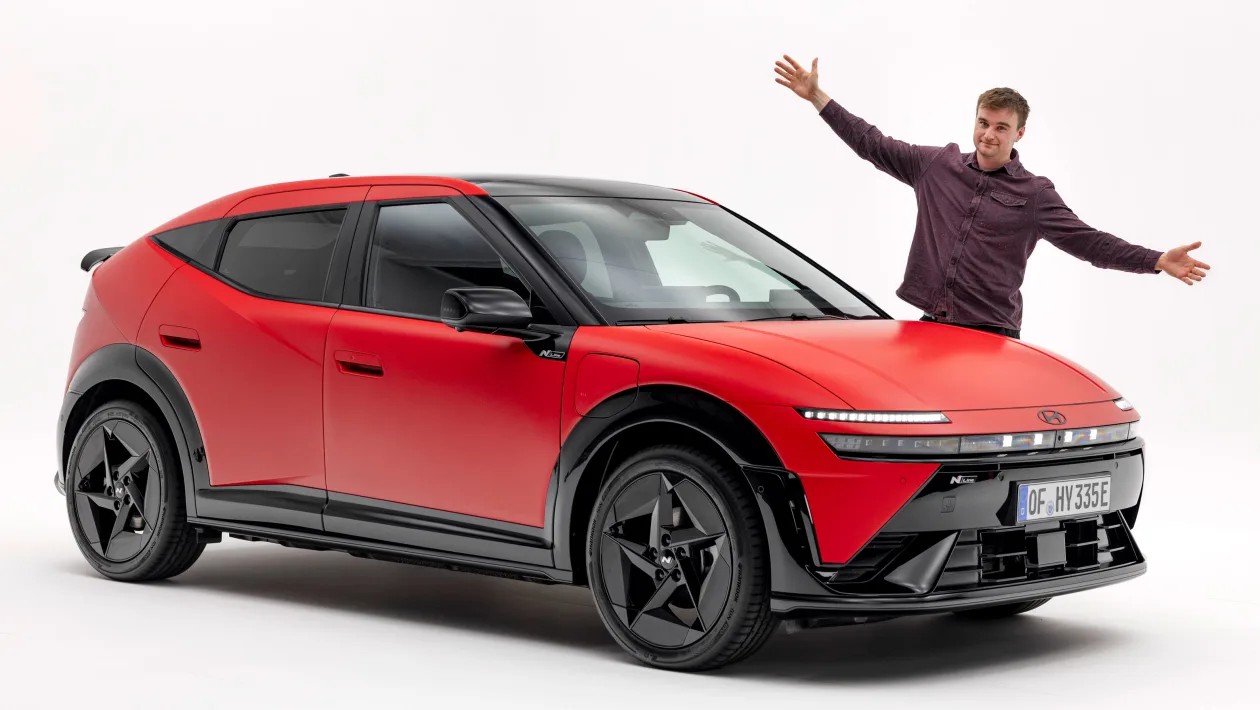
The Ioniq 3 is being marketed as an “aero hatch,” a design philosophy that prioritizes efficiency through shape. While it retains the futuristic spirit of the “Concept Three” shown last year, the production model is more grounded.
Key design features include:
– The “Art of Steel” aesthetic: Sharp creases along the side profile that lead toward a rear spoiler.
– Aggressive Stance: Color-contrasting wheel arches give the car a wide, planted look.
– Intentional Boldness: Hyundai designers have openly stated they want a “polarising” design, aiming to turn heads rather than blend in.
The revealed N Line trim adds a sporty edge with 19-inch wheels, a functional diffuser, and red accents. Interestingly, while the concept featured a fake exhaust to provide external sound, this has been omitted from the standard production model—though it may return in a future high-performance “N” variant.
Interior: Tactile Tech and “Pleos”
Inside, Hyundai is attempting to strike a balance between modern digital interfaces and traditional usability. While the car features large 12.9-inch or 14.6-inch displays, Hyundai has resisted the industry trend of moving every single function into a touchscreen.
Drivers will still find physical switchgear for climate control, driving modes, and seat adjustments, offering a tactile experience that many users find more intuitive than menu-diving. The infotainment system is powered by “Pleos,” a new Android-based platform designed for ease of use.
Practicality remains a focus, with a 440-litre boot (with the load-bay floor removed) and clever storage solutions, such as a large flask area under the center console.
Performance and Range: Efficiency through Aerodynamics
The Ioniq 3 is built on a modified version of the E-GMP architecture, sharing much of its DNA with the Kia EV2. However, Hyundai has managed to edge out its sibling in terms of pure efficiency.
| Feature | Standard Range (42.2kWh) | Long Range (61kWh) |
|---|---|---|
| Estimated Range | Over 208 miles | Over 304 miles |
| 0-62mph Time | 9 seconds | 9.6 seconds |
| Power | 144bhp | 134bhp |
Why the range difference matters:
The Ioniq 3 boasts a remarkably low drag coefficient of 0.26. This aerodynamic efficiency allows it to achieve significantly higher ranges than the Kia EV2, despite using similar battery technology. For drivers, this means more miles per charge and potentially more predictable long-distance travel.
Charging is equally efficient; the standard range model can charge from 10% to 80% in approximately 29 minutes.
Market Outlook
While official pricing is still pending, the Ioniq 3 is expected to arrive in the UK later this summer. Given that its sister model, the Kia EV2, is eligible for the UK Government’s £1,500 Electric Car Grant, industry analysts expect the Ioniq 3 to follow suit, potentially starting at a competitive £25,000.
The Ioniq 3 represents Hyundai’s strategic move to capture the mass market by combining distinctive, high-concept design with highly efficient, practical electric drivetrains.
In short, the Ioniq 3 is a stylish, aerodynamically optimized compact EV designed to compete in the increasingly crowded and price-sensitive small-car segment.