


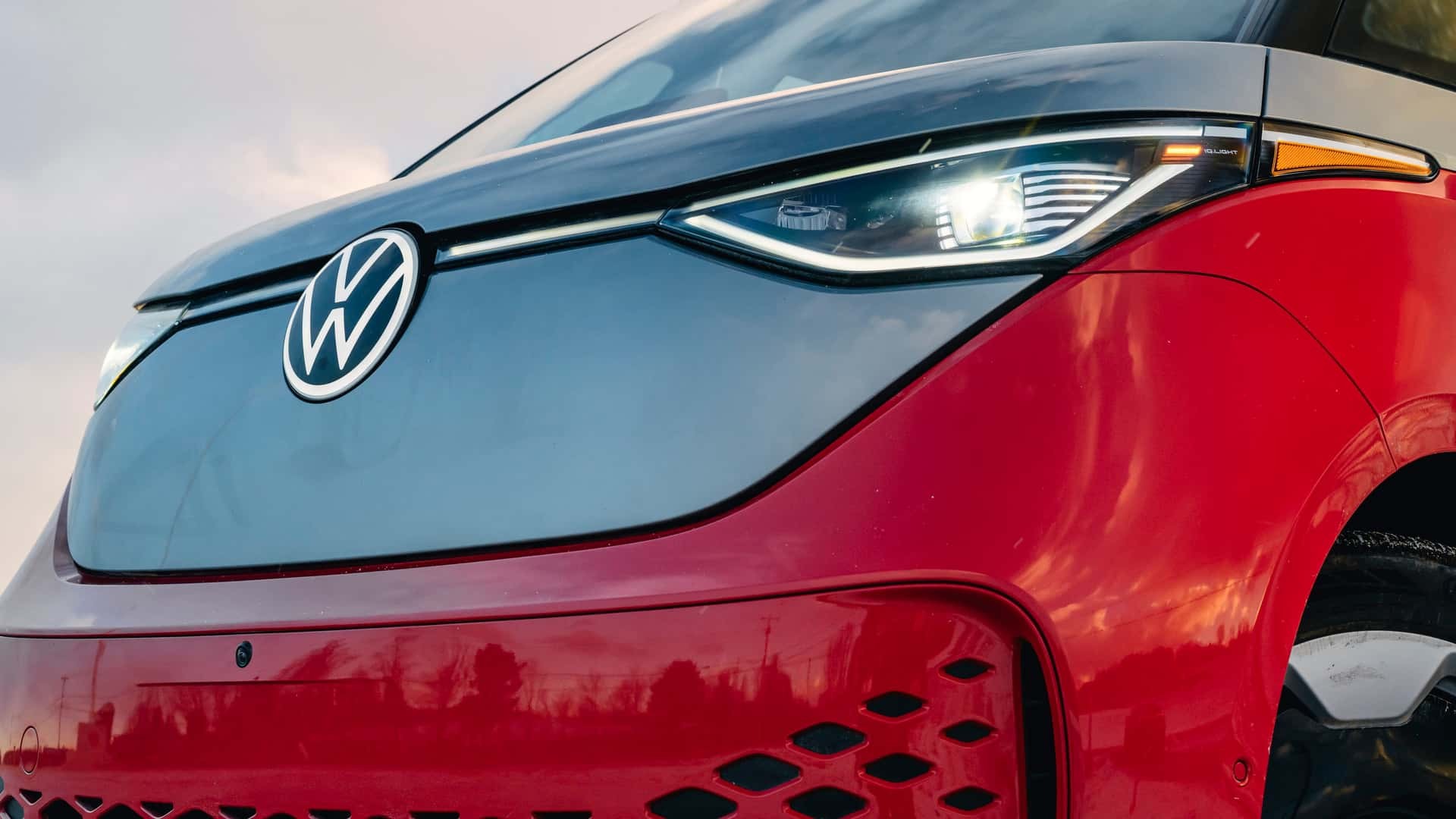
VW Commercial Vehicles has a simple explanation for why you won’t be seeing a gas-powered generator under the hood of the ID. Buzz: there is nowhere to put it. The short front overhang leaves zero room for an internal combustion engine.
So, a range-extending version is unlikely. It’s not happening.
This isn’t just theory. In a chat with GoAuto, Stefan Mecha, head of VW Commercial Vehicles, confirmed the idea was explored but shelved due to hard packaging constraints. The MEB platform, on which the ID. Buzz rides, was engineered exclusively for battery-electric powertrains. It’s a dedicated architecture. There’s no spare space hiding in the front bumper for a small generator.
The ID. Buzz sold well globally in 2025. 60,700 units moved. It was the eighth best-selling electric vehicle within the entire Volkswagen Group. Demand doubled compared to the prior year.
But the U.S. tells a different story. Only 6,140 minivans were sold across the Atlantic. That weak showing triggered an unexpected strategic pivot. Volkswagen canceled the 2026 model year entirely. It’s clearing out 2025 inventory to prepare for a 2027 return.
The official statement pointed to weak EV adoption in the market. A “careful assessment” led to the hiatus. But let’s look at the numbers that likely hurt sales the most.
The rear-wheel-drive model offers a modest 234 miles of range. It starts at $61,545. Those are steep hurdles for the average American buyer. While VW didn’t cite range or price as reasons for the 2026 cancellation, they clearly matter to the customer base.
Does range anxiety kill sales? You bet it does.
VW did consider a solution. They looked into an extended-range electric vehicle (EREV) powertrain. A gas engine would act as a generator, boosting range and easing buyer hesitation. It makes sense on paper. It doesn’t work on the MEB platform.
The platform is shared with over 20 other models. The ID.3 through the ID.7 Tourer all use it. It even powers the Ford Explorer and Capri. Rear-wheel-drive-based, yes. But strictly electric in layout. No combustion engine housing exists.
VW hasn’t abandoned the concept of range extenders globally, however.
In China, the ID. Era 9X launched recently. It’s a large six-seat SUV co-developed withSAIC. It uses a 1.5-litre gasoline engine strictly to charge the battery. Fewer charging stops. Better range.
The new Scout brand will bring EREV versions of the Traveler and Terra to the U.S. in 2027. These vehicles are designed with that flexibility in mind from day one.
Wider speculation from Bloomberg late last year suggests VW is weighing range extenders for Europe and North America too. The next-generation SSP platform is being built to accommodate this. It will likely debut in an Audi around 2028, followed by Porsche and Skoda models. Eventually, SSP could replace current EV-only architectures.
The ID. Buzz is on older tech. It’s on MEB. That’s the bottleneck.
Motor1’s Take: An EREV ID. Buzz might have saved it in the U.S. market. But we won’t get it. VW isn’t giving up on the minivan, though. The 2027 model returns with new colors. New wheel designs. Conventional buttons on the steering wheel, finally ditching the touchscreen obsession.
The Tourer variant bundles a fold-out mattress. A platform for gear. Window blinds. Front window ventilation. An exterior table and chairs included. It’s turning the ID. Buzz into a camper.
A range-extending ID. Buzz would have addressed the primary complaint about long trips, but the physical space just isn’t there.
Pricing remains the wildcard. If it comes down, the ID. Buzz could win over more Americans. There’s also the charging situation. VW continues shipping with a NACS adapter rather than a native port. That’s a friction point. Some buyers might walk away because of it.
The minivan survives. It adapts. It just doesn’t have a gas engine. Not in America. Not on the MEB platform. The road ahead is electric. Long, sometimes lonely stretches of it. But electric nonetheless.


