The idea sounded right. A return to form. Pop-up headlights on a new Ferrari Testarossa would have felt like destiny, echoing the 512 BB and F40 before it. Designers at Maranello actually ran with this. Jason Furtado, a lead designer on the 849 Testaraossa, confirmed the team looked deeply at their history. They studied concept sketches from the seventies and eighties. They looked at production legends.
Did Ferrari seriously consider bringing back pop-up headlights?
Yes. It was a serious proposition during the early stages of the Ferrari 849 Testarossa design process. The team wanted that specific retro flair, the kind that makes you recognize a Ferrari from fifty paces away. The pop-up lid was iconic. But reality bit back hard. Modern regulations.
It wasn’t just one rule that killed it. It was every rule, everywhere. The car has to pass homologation in China, the US, and Europe simultaneously. Each market has its own strict safety code. Layer them on top of each other, and moving mechanical parts for lighting become a nightmare to certify.
Why pop-up headlights failed the safety test
The requirements are simply unviable for a global production model now. Back in the eighties, you could build a 288 GTO and worry about a limited series certification. Today, the 849 must sell millions? No, not millions, but thousands. It needs to be sold everywhere. The cumulative weight of these regional regulations made the mechanism too complex, too risky, and too slow to certify.
So they compromised. Or did they innovate?
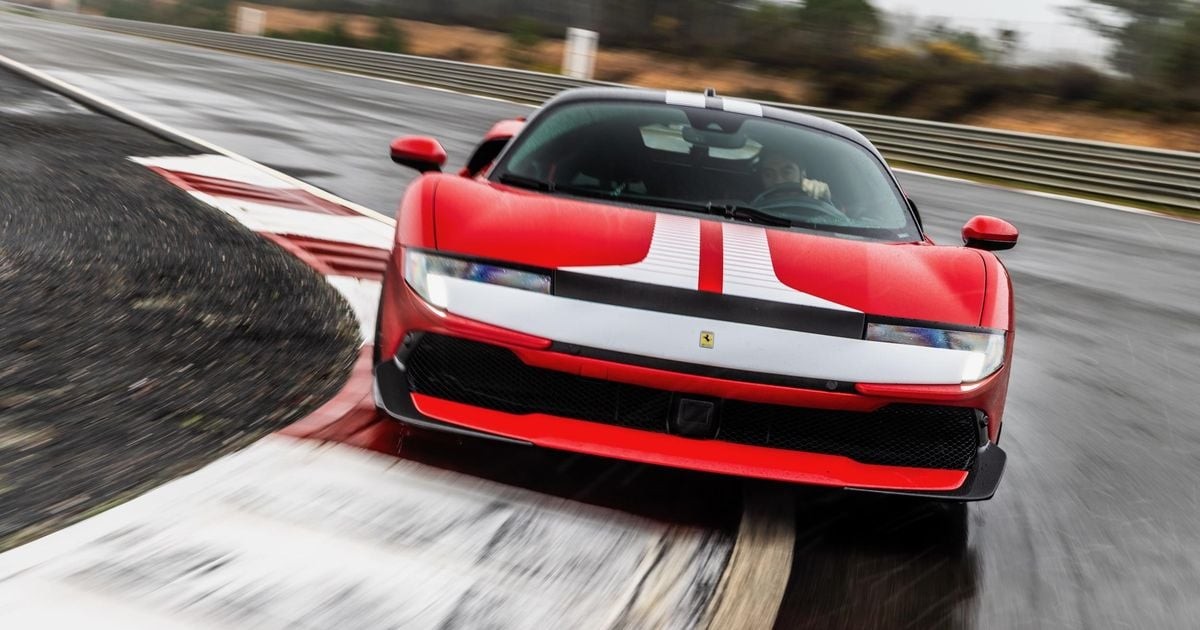
They squished the fixed lights into a thin, black strip. A bridge. It runs right across the front nose of the car. From certain angles, when those lights are off, the sleek fascia mimics the look of an older Ferrari with the lids closed. It is a deliberate nod, not a copy. Ferrari calls it a tribute to the 288 GTo, but functionally, it keeps the profile sharp.
How the 849 references Ferrari’s prototype past
If you are asking why the front of the new Ferrari 849 looks like that, look away from the street cars and look at the race cars.
The designers didn’t want to remake the 1984 testarossa side-strake car literally. That’s easy enough, but boring. They went deeper. Their primary inspiration? The 1970 sports prototypes. Specifically the 512 S.
The flowing, voluptuous shapes of the sixties were gone. Aerodynamics took over. Brutalist boxes ruled because engines were hotter, air needed to move faster, and cooling required larger intakes.
That is the vibe here.
Look at the doors. They are deeply sculpted. Not just pretty sheet metal. That single aluminum pressing channels air all the way to the rear. Behind the door, those vertical black vents aren’t decoration. They pinch the waist. It’s a corset effect. The goal is to make the car look lower, shorter, and lighter. It works.
Comparing downforce: 512 M vs. the hybrid era
The rear pays the most direct homage. Twin tails. Right out of the 512 M playbook.
But this isn’t just styling for nostalgia’s sake. Physics demands function. Those twin passive air devices grab the high-energy airflow spilling off the rear wheel arches. They generate 10% of the rear downforce just by being there. No motors, no electricity. Just shape and wind.
They team up with an active spoiler that flips between low-drag and high-grip in under a second. Fast enough to matter, slow enough to feel deliberate.
Is it weird that a PHEV looks like a 1970 GT racer?
Maybe. But Ferrari designers say that freedom to diverge is their superpower. The 849, the 12Cilindrri, the F80. None of them look like siblings. You don’t see that rigid “family face” forcing a logo into every crevice like some other manufacturers do. Furtado says they draw from fighter jets, industrial design, aviation history. It is a scattergun approach to inspiration.
And yes, it causes noise online.
People hate change instantly. They post angry tweets about the front end. Furtado brushes it off. He says you change your mind when you see it in person. You have to be there. Online, it’s flat. In 3D, you get it. The design team refuses to play it safe just to appease Instagram comments.
“We have to make a new desirable object,” Furtado says. “For the imagination.”
Spec sheet and availability for Australian buyers
The drama is real. So are the numbers.
The 849 Testarrosa replaces the SF90 Stradale as the halo hybrid. It keeps the 4.0-liter twin-turbo V8 but tweaks the hybrid system. Three electric motors help out. Total system output sits at 772 kW. That is a lot of power for a car that weighs… well, enough to need those downforce figures.
How fast is the 849 Spider really?
Ferrari claims the top-spec Spider hits 100 km/h in under 2.3 seconds. It’ll rip to 200 km/h in 6.5 seconds. The top speed exceeds 330 km/h. It sounds like cheating, mostly because the electric fill is instantaneous, but that V8 scream is still the heart of it.
Price? Let’s not dwell, but you have to know.
- Coupe : Starts at $932,640 in Australia (before ORC).
- Spider : Starts at $1,015,858 (before ORC).
Deliveries won’t wait forever. The Coupe arrives first, roughly in the first half of next year, followed by the Spider about six months later in the first quarter of 2027.
The lights didn’t pop up. The name stays. The history lingers in the shape of the air, even if it won’t lift.