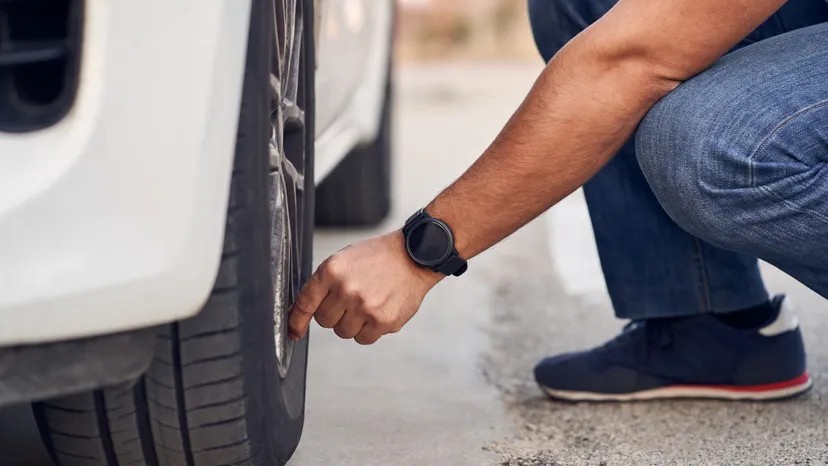
Look down. Seriously, bend over and stare at your tires. They aren’t round. At least not where they meet the pavement. The bottom is flattened. That squished zone is the contact patch. It’s the only part of your car actually touching the road.
If you had a glass road and could peek underneath a two-ton sedan, you’d see a small rectangle of rubber. To find the total footprint, you multiply length by width for one tire, then multiply by four. Simple geometry. But here’s the weird part: that area is roughly equal to your car’s weight divided by the tire pressure.
Let’s do the math. Take a 4,000-pound car. Inflate those tires to a standard 30 psi. Divide 4,000 by 30. You get 133 square inches. That’s the total area for all four tires. Spread that out over four tires, and each patch is about 33 square inches.
Now, consider the width. Most street tires are roughly 7 inches wide. If you divide that 33 square inches by 7 inches, you get a contact patch length of about 4.75 inches per tire. Less than half a foot of rubber on the ground holding up a heavy metal box.
It feels like more. It probably is more.
Go measure it. Take a tire and slide two sheets of paper under it until they stop. Mark the distance. You’ll likely find the patch is longer than the calculation suggests. Why? Because pressure isn’t uniform.
At the very edge of the contact patch, the tire is just kissing the asphalt. Almost no weight. As you move toward the center, the load increases. The pressure distribution is a curve, not a flat line. The calculation assumes uniform pressure, which isn’t how rubber works.
Drop the pressure to 7.5 psi. That’s a quarter of the original 30 psi. You’d expect the patch to quadruple in size. It won’t. The sidewalls take over.
Tires aren’t just bags of air. They’re complex structures. When pressure drops, the rubber and belts in the sidewall begin to bear the load. The tire stiffens up structurally. It doesn’t squish infinitely.
This is why low-profile tires behave differently than those chunky SUV tires. Sports cars run on stiff, short sidewalls. They resist deformation. You get a narrower, sharper patch. SUVs have tall, flexible sidewalls. They squish more. They distribute weight differently.
Then there are run-flat tires. These things are built so stiffly they can run with zero air pressure. The structure alone holds the car up. No air needed. The contact patch changes shape, but the tire doesn’t collapse.
“The structure of the tire starts to bear some of the weight of the car.”
So, that 4.75 inches? It’s a baseline. The real world is messier. Rubber stretches. Sidewalls flex. Pressure varies.
You might be wondering which tire width gives you the best grip without sacrificing fuel economy. Or how run-flat tires affect ride comfort compared to standard sidewalls. The answers aren’t in the math alone. They’re in the rubber.
Check your pressure again. Is it really 30 psi? Or did you miss the spot? The patch is waiting.