Your rig needs to be dialed in before you hit the pavement. Proper tire pressure, a clean alignment, and a balanced load aren’t just for comfort. They prevent catastrophic failures down the line. When you start dragging a heavy payload, though, the physics change. The extra mass behind the axle throws off the steering dynamics. Your front end wants to wander.
This is where steering stabilizers come in. They don’t replace your suspension. They don’t fix a bad alignment. They provide a buffer against the chaotic forces of towing. Think of them as extra insurance for your steering rack.
You won’t be doing donuts after installing one. That’s not what they’re for. You’re looking for straight-line stability, not agility. If you want to dance around cones, you’re barking up the wrong tree.
There are four main types of steering stabilizers for tow vehicles. Coil springs. Coil-hydraulic hybrids. Pure hydraulics. And gas springs. None of these are mandated by law for trucks or RVs. But most drivers install them because the factory setup feels sketchy under load. They work like shock absorbers for your steering linkage. The difference? Shocks stand up. Steering stabilizers lay flat, mounted horizontally near the steering knuckle.
Coil Spring Steering Stabilizers
Coil spring stabilizers are the simplest design. They use a spring to dampen oscillations. It’s straightforward. There are fewer moving parts to break. But they lack the consistency of hydraulic or gas systems.

A coil spring is essentially a metal rod twisted into a flexible spiral, resembling the railing of a helical staircase. You will encounter two distinct variants: tension coil springs and compression coil springs.
Tension springs resist elongation. They function much like a bungee cord. The classic Slinky toy is a prime example of a tension coil spring. Stretch it out, and it fights to pull itself back together.
Vehicle steering systems rely on the other type. The compression coil spring is the component used for steering control. It resists being pushed together. When you apply downward force to compress the metal components, the spring pushes back. Release the force, and it springs back to its original shape immediately.
These spring-based steering stabilizers maintain the wheels’ center position. They hold a “memory” of where straight-ahead is. When you rotate the steering wheel, you compress the spring. Release the wheel, and the stored tension drives the mechanism back to neutral.
But springs alone lack damping. They oscillate.
Coil-hydraulic Steering Stabilizers
This is where the hydraulic design diverges from the simple spring. A pure coil spring provides reactive force but no resistance to speed. Hydraulic steering stabilizers add a fluid chamber to the mix.
How do coil-hydraulic steering stabilizers differ from the coil spring design? The addition of hydraulic fluid introduces damping. It smooths out the oscillation. Instead of bouncing back and forth indefinitely, the wheel returns to center with controlled decay.
The hydraulic fluid forces its way through small orifices within the piston. This creates resistance proportional to the speed of the steering input. Fast movements are met with higher resistance. Slow adjustments feel lighter.
This combination addresses the “memory” function of the spring while eliminating the bounce. The spring still seeks the center position. The hydraulic cylinder ensures the vehicle doesn’t wiggle after hitting a bump at highway speeds.
Traditional springs can leave the steering feel “nervous.” The hydraulic component tames that energy. It provides stability without adding significant effort to turn the wheel at low speeds.
The next section covers how hydraulic fluid pressure interacts with valving systems to fine-tune this response.

Hydraulics aren’t just for the heavy hitters. We usually associate fluid power with bulldozers, cranes, and forklifts, but the technology is hiding in plain sight in smaller, simpler machines too. Your car’s braking system is a prime example.
When you stomp on the pedal, you aren’t just pressing metal. You are forcing a piston against an incompressible fluid. That pressure travels through the lines to slave pistons at each wheel. The fluid pushes those pistons, clamping the brake pads against the rotors. The car slows. Simple physics.
But let’s talk about steering. Specifically, the coil-hydraulic steering stabilizer.
These units work a lot like traditional coil springs. When you turn the wheel of a tow vehicle or a heavy truck, the coils compress. They want to resist that movement. When you let go, they push back, snapping the wheels toward their original straight-ahead position.
There is a catch, though. Without dampening, that snap-back can be violent. It can cause oscillation, or “death wobble,” in larger rigs. That’s where the hydraulic component steps in.
The Shock Absorber Effect
A coil-hydraulic stabilizer isn’t just a spring. It has a piston right in the center. This piston acts exactly like a shock absorber in your suspension.
Think of it this way: the coil spring does the heavy lifting, providing the return force. The hydraulic piston manages the speed. It works in tandem with the spring to provide extra stability. It keeps the spring from snapping back into place too quickly.
Without the hydraulic damper, the spring energy would cause the steering wheel to jerk in your hands. The fluid resists the piston’s movement, smoothing out the return.
This setup is critical for vehicles that tow heavy loads. The added weight and wind resistance can make the front end twitchy. A simple mechanical spring might bounce too much. The hydraulic stabilizer adds resistance proportional to the speed of the movement. Fast jerks meet heavy resistance. Slow adjustments feel natural.
Why Springs Alone Aren’t Enough
What happens if you remove the spring entirely? Purely hydraulic steering systems exist, but they operate on different principles. They rely on fluid displacement to create resistance and return forces, but the dynamics are entirely different from a spring-loaded system.
We will look at how purely hydraulic steering works next.
Most drivers assume their steering system is a simple mix of metal and fluid. It isn’t. Understanding the difference between coil-hydraulic and fully hydraulic setups changes how you view stability under load.
Coil-hydraulic steering control relies on a hybrid approach. You get the mechanical resistance of a spring paired with hydraulic dampening. It’s assisted. The hydraulic power doesn’t do everything; it just helps.
Fully hydraulic systems are different. They strip away the mechanical spring entirely. The vehicle’s steering stability comes solely from hydraulic pressure. No metal coil. No mechanical return force. Just fluid dynamics dictating the wheel’s behavior.
The Shock Absorber Lookalike
A hydraulic steering stabilizer mimics the coil-hydraulic setup but removes the spring. It’s not a compromise; it’s a specialization.
Without a compression coil spring to force the wheels back to center, hydraulics handle the entire return-to-center action. They dampen the oscillation. They control the oscillation.
Visually, it’s deceptive. Aside from horizontal mounting, a hydraulic stabilizer looks identical to your car’s suspension shock absorber. It acts like one, too. It resists rapid movement. It smooths out the jarring impacts from uneven pavement.
Where They Fit
You won’t see these on a daily commuter sedan. You see them on large tow vehicles.
Heavy towing introduces chaos. Extra weight creates inertia. Inertia fights steering inputs. Hydraulic stabilizers thrive in this chaos. They provide stability that springs can’t match. They offer smoother control when the trailer is pushing back against you.
The result is less fighting. More precision. A steadier hand on the wheel when the load is heavy.
Hydraulic systems don’t just dampen bounce. They dictate the return path.
The Next Evolution
We’ve covered the spring-assisted and fully hydraulic methods. But the market is shifting again.
The newest generation of stabilizers for towing uses gas springs. They operate on a different principle entirely. Nitrogen replaces hydraulic fluid in some designs, or supplements it in others.
We will break down how gas spring technology works next. It’s not just an incremental upgrade. It’s a fundamental change in how we handle steering feedback.
How Gas Springs Dampen Steering Wobble
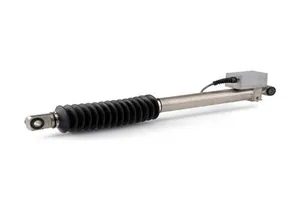
Most people assume shock absorbers are just for bumps. But in heavy towing setups, the real enemy is steering wander. That’s where gas springs step in. You see them in hospital beds, gym equipment, and aircraft landing gear. They don’t look like standard coil springs. They look like syringes. Cylinders with a piston inside.
The piston compresses gas to provide force. This force keeps your wheels straight. Oil circulates around the piston to lubricate the cylinder wall. Smooth movement. No binding.
If you’re pulling a fifth wheel or a heavy travel trailer, your steering stabilizer choice matters. Not all systems are created equal. Pick the wrong one, and you’re fighting the wheel all the way to the campsite.
Why Your Tow Vehicle Needs the Right Stabilizer
Safety isn’t a suggestion here. It’s a requirement. When you’re hauling tons of steel and wood, every steering correction counts. Look into each specific system before you buy. Compare specs. Read reviews. Don’t just grab the first one on the shelf.
Doing your homework extends the life of your steering components. Saves you money on repairs. And maybe, just maybe, prevents driver fatigue. You shouldn’t have to wrestle the wheel to stay in your lane.
“Gas springs are cylinders that look and act similar to a syringe. Within the cylinder is a piston, which works to compress the gas and provide a force to aid in keeping the wheels straight.”
The Mechanics of Stability
Gas springs don’t look like typical coil springs. Instead, they’re cylinders. Oil circulates around the piston to keep the area between the piston and the cylinder wall well-lubricated. This allows smooth movement. Without it? Vibration. Shaking. Fatigue.
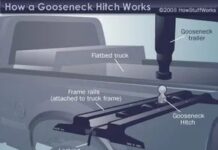
The type of steering stabilizer you consider depends on your tow vehicle. A Class C motorhome has different needs than a pickup with a gooseneck hitch. Know your rig. Match the stabilizer.
Extra safety during towing trips comes from preparation. Investigate each system. Pick the best steering stabilizers for your tow vehicle. It’s not just about comfort. It’s about control.
More information about steering stabilizers and other towing systems is available in subsequent guides. Related articles cover cargo carriers, drawbar pull, breakaway kits, and fifth wheel hitches. Top towing risks are also outlined for those who want to stay safe on the road.
Sources include iCARumba, Industrial Gas Springs, Magnus Mobility Systems, FourWheeler.com, and Towing World. Links to etrailer.com provide additional hardware options. The details are there. You just need to read them.