R1S and R1T buyers screamed for physical buttons. They were right to complain. Everyone else did too. We’ve watched the auto industry trade tactile knobs for glossy touchscreens until the dust settled on what people actually want. A button that clicks. A dial you can feel.
Rivian heard the feedback. They decided not to just give customers what they asked for in the new R2. Instead. They got clever. Or perhaps too clever.
Enter the Haptic Halo
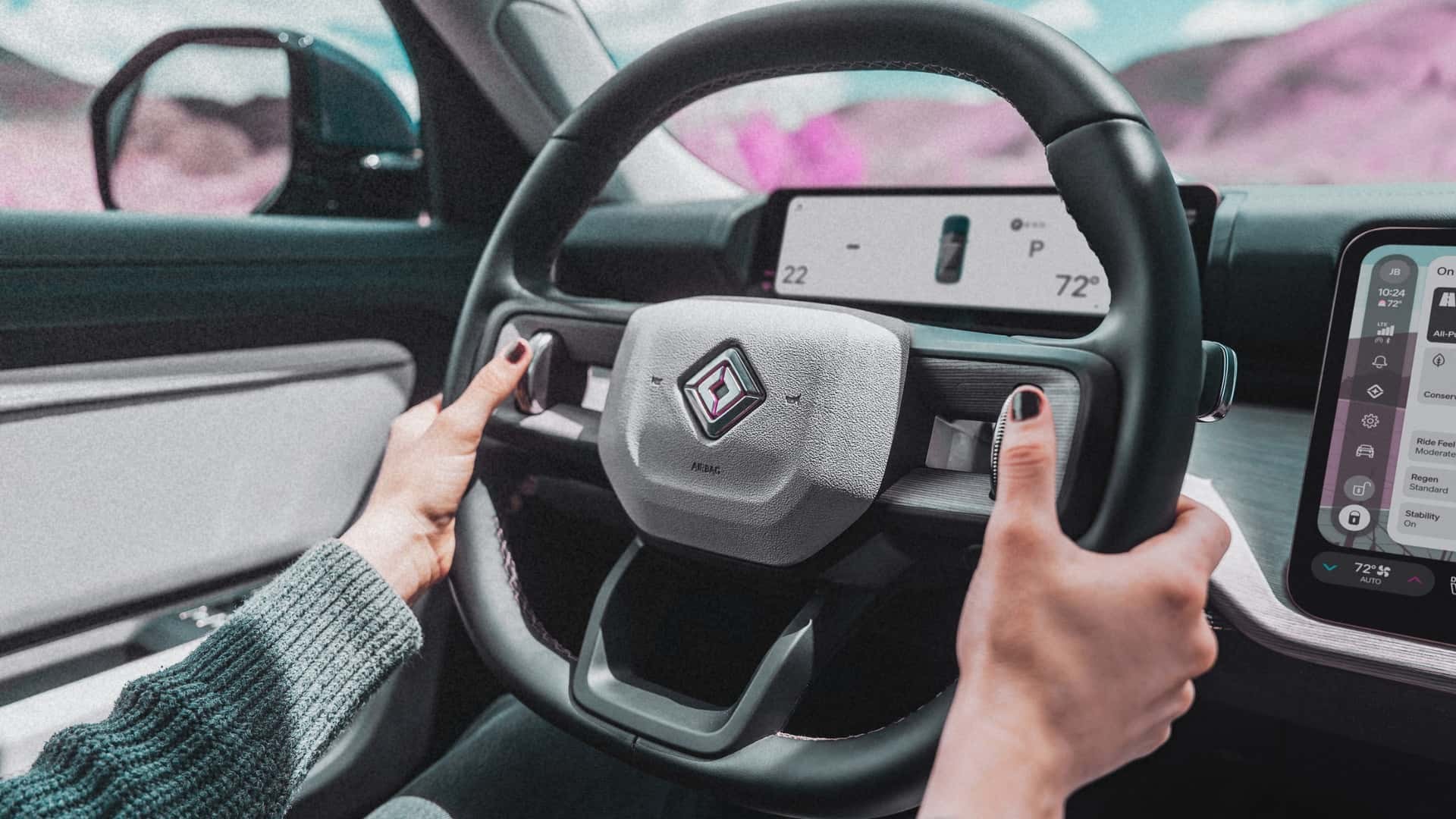
The R2, a compact SUV focused heavily on keeping manufacturing cheap, introduces controls Rivian calls Haptic Halo. Two circular dials flank the steering wheel. They look like traditional volume or climate knobs. They are not.
Roll them up or down. Side to side. Push them in. The theory is sound for a software-defined company. Adding dedicated hardware for every function wastes money. Streamlining is key when you are trying to sell an EV that isn’t wildly expensive. So we got Halos. Buttons vanished.
Photo by: Rivian
Here is how they are supposed to work. The left side handles audio. Up and down adjusts volume. Left and right changes the track. Press down to mute. If you scroll hard enough. The dial fights back. There is resistance at the extremes. It feels intentional. Nifty.
The right halo? Mostly climate. Scroll up to warm the cabin. Down to cool it. Pull back on the ring to switch drive modes. Push it side-to-side to toggle other vehicle settings. A single component doing the work of ten separate switches. Efficient? Yes. Frictionless? Debatable.
Photo by: Rivian
Adjusting volume or temperature works fine. Your eyes stay on the road because the haptic resistance tells you when to stop. That part works. Everything else is a struggle.
It breaks easily
Try muting the stereo. You need firm pressure. Too firm. My thumb inevitably slipped, scrolling the volume instead of killing the sound. Pulling the right halo back to change drive modes required a yank. Pulling the left halo? Nothing happened. Probably not coded yet. Maybe never will be.
Swipe left to change a song? Good luck not bumping the volume. You chase that next track and end up with deafening static or silence. It happens on highways. It happens worse on dirt. We drove off-road. Rough trails shake your grip on the wheel. The vibrations make accidental inputs inevitable. One shudder. You just blasted your aux or dropped the temperature five degrees.
Why does this fail? Because there is no mechanical feedback. The Halos rely on capacitive touch sensors paired with haptic motors. It mimics the feeling of movement without any of it. Most carmakers have tried this. Most fail. Rivian isn’t an exception, even if theirs are slightly less annoying than the competition.
Simpler should win
Am I being picky? Sure. The R2 is a great truck. It handles road and dirt with competence that defies its price tag. These Halos work better than the vague touch-pads found in most sedans. Better is not enough though.
Rivian had a chance. They could have just added a knob. A real one. With springs. They would have saved us from the guesswork. They would have respected the driver’s instinct to touch without thinking.
They didn’t. They chose consolidation. They chose cost-saving over intuition.
Simplicity is not the absence of features, but the presence of clarity.
Sometimes you just want a dial that clicks. Rivian proved they don’t. Or they can’t afford to. The Halos remain. Clunky. Over-engineered. And frankly. Unnecessary.
Photo by: Rivian