The Volvo EX30 was supposed to be a revolution. A $35,00 electric vehicle that could finally prove legacy automakers weren’t just dragging their feet on electrification. Volvo had already made moves with PHEVs and owned stake in Geely, a Chinese giant pushing hard on EVs globally. The XC40 Recharge started things off nicely enough.
So, the logical next step? A market-shattering compact EV.
Right?
Wrong.
The EX30 has only been sold in the United States for under two years, and Volvo is already killing it. I spent a week driving the Cross Country version to figure out why this specific model became a footnote rather than a flag-bearer.
Exterior: The Only Reason to Buy
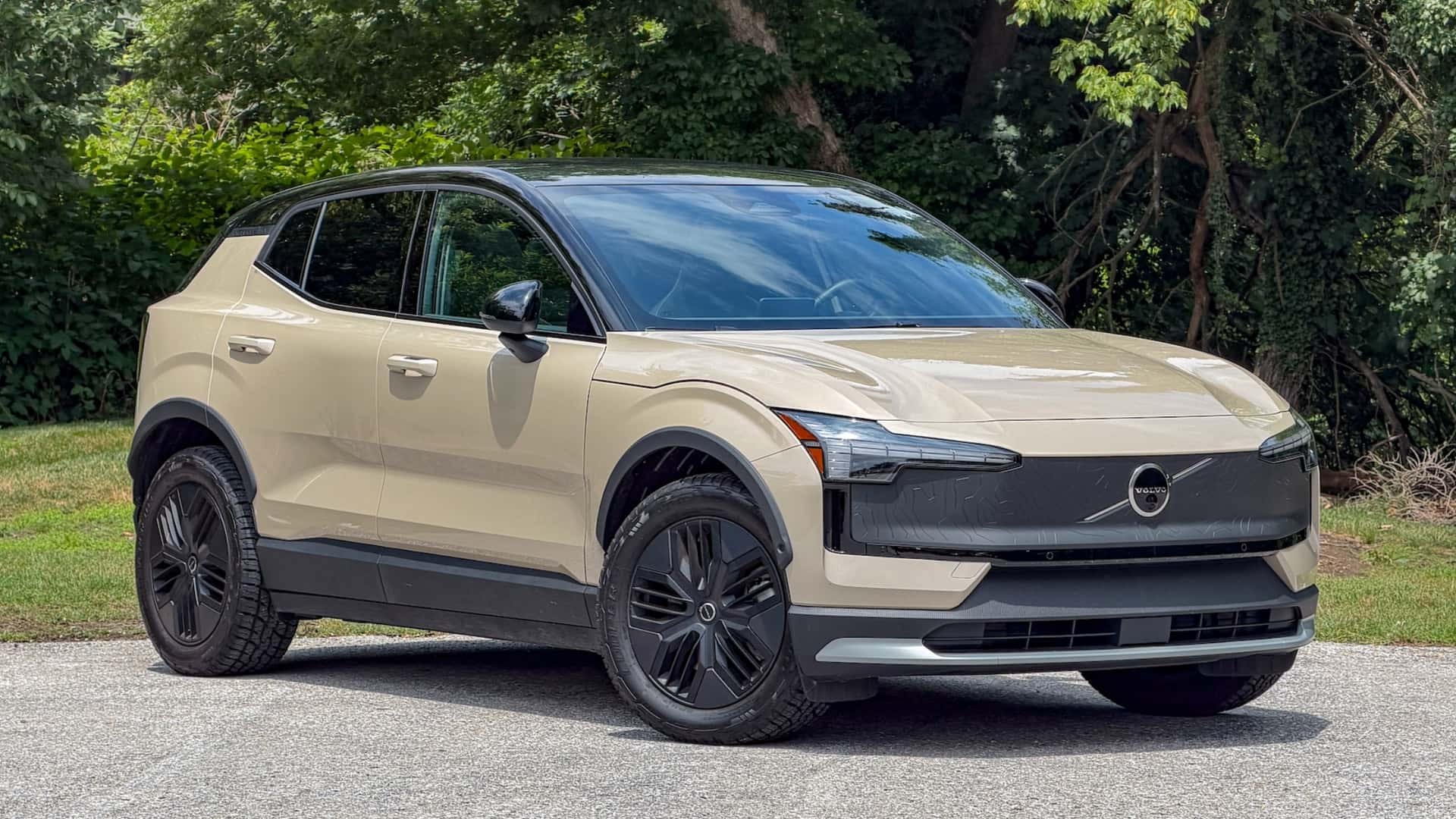
The EX30 scores big points visually. It’s a handsome little machine that looks bigger than it is—a trick of the light and styling. The Cross Country trim adds Volvo’s signature weirdness: a “grille” that is actually a topographic map of a Swedish mountain. Add in black accents and blocky new headlights, and you get a distinct Scandinavian aesthetic.
The Sand Dune color is excellent, though it reminds me of a high-end German taxi. Volvo knows how to do neutral tones, and having this as an exclusive trim option sets it apart from the sea of plastic cladding everywhere else. Look closely, and you’ll find hidden moose (or mooses) scattered across the body. It feels authentically Swedish in a way the other models often miss.
Interior Design vs. Usability
The interior starts strong. Green wool-blend seats look and feel premium. The space-age door handles are over-the-top, sure, but they fit the vibe. Then there’s the Harman Kardon soundbar running along the windshield. Finally, a sound system that isn’t an afterthought.
That’s where the praise ends.
The Cabin Confusion
I have no idea what Swedish engineers were thinking when they placed the USB-C ports. They are on the floor, under flaps that make them nearly impossible to reach, let alone use while driving.
Climate control is another mystery. The vents are hidden. Adjust them via the screen? Fine. Want to point airflow down? Close the vents entirely instead. And forget about rear passengers controlling their temp. The vents are all up front, so back-seat riders get whatever temperature you decide on.
The 12.3-inch central screen does everything. Open the glovebox? Screen. Change radio stations? Screen. Why? Probably to save costs by not engineering dual dashboards for left-hand and right-hand drive markets. But forcing simplicity that isn’t actually simple makes the car feel hostile to use.
Then there is the navigation. Volvo uses Google Maps. I asked it to take me from Baltimore to Rehoboth Beach, Delaware. It suggested four charging stations. In reality, there are dozens. The system hides infrastructure unless you manually search for it. This actively punishes drivers with limited range.
Apple CarPlay is available, but it works intermittently. You can connect, but good luck getting music to stream or the interface to launch reliably. It feels like a half-baked integration.
I haven’t even mentioned:
* The missing center console (now just cupholder storage)
* Window controls that you must toggle between front and rear
* A wireless charger that takes three hours to add 30% charge
* Sticky haptic buttons on the steering wheel
* A speedometer that beeps at you if you look at it
To open the trunk, you don’t just tap. You have to long-press. Why? No one knows.
Space and Storage
The rear seat area is… okay. It’s typical small European crossover space. Legroom is tight. The flat floor helps headroom, which is better than the roofline suggests. But don’t expect family hauler status.
Trunk space is 11.2 cubic feet up. 27.8 with seats down. You can fit two large suitcases or five 20-lb bags of ice. That’s it. If you try to pack for a family of four, you’ll fail.
Performance: Fast But Inefficient
The EX30 Cross Country uses a 69-kWh battery. It makes 422 hp and 400 lb-ft of torque. All-wheel drive sends that power to the ground, making it the fastest Volvo ever. 0-60 mph in 3.4 seconds.
Unnecessary power? Absolutely. Drive it in anything other than “battery-saver” mode, and it wheelspins constantly. The throttle response is twitchy, similar to a Jeep Wagoneer S or a laggy Chromebook.
However, when you do drive it calmly, the handling is excellent. Despite weighing 4,151 lbs, the car feels agile. It eats up Baltimore’s winding roads without excessive body roll. The driving dynamics are the best part of this car.
The Range Problem
Volvo claims 227 miles of range.
This is not true in the real world.
I drove 140 miles one way. The car consumed the energy of roughly 170 miles of EPA-rated range. I drove in battery-saver mode to achieve this. Turn off saver mode, and the battery drains aggressively fast.
Charging is also problematic. The EX30 uses CCS ports, not the Tesla NACS standard. You need an adapter or a stop at Electrify America. When it works, you can spend 20 minutes scrolling Instagram. But when it fails, you’re stuck. I encountered issues with non-fast chargers disconnecting mid-session, showing “loose plug, charging stopped” before cutting off. This makes long trips tedious and stressful.
The Verdict on Price
The sticker shock here is real. The EX30 Cross Country starts at $49,545 after options.
This is not the $35,0, 300-mile car Volvo advertised. This is a $50,0,00 EV with worse range than a base Toyota bZ4X. The interior frustration, the questionable tech choices, and the poor real-world efficiency make this price point unjustifiable. It’s not just overpriced; it feels disrespectful to the buyer.
Conclusion
The Volvo EX30 feels unfinished. It’s still in beta software and hardware maturity. Selling it at this stage to the general public was a mistake. While it’s not quite as disastrous as some competitors, it is borderline unacceptable for a brand known for quality.
I own a Volvo. I’ve supported the brand for years. It hurts to see them stumble this hard. The plug has been pulled on the US market, and Volvo is reportedly replacing it with a revised version (often rumored as the EX60 or a reworked EX30).
I hope that next car delivers on the promise. But for now? I’m skeptical. This specific configuration of the EX30 should never have been sold at this price. The experiment failed, and the American market got burned in the process.
Competitors to Consider Instead
If you need a compact EV that actually works:
- Nissan Leaf: Still an option, though aging tech.
- Tesla Model Y: Better range, better charging network, and likely cheaper.
- Toyota C-HR (or bZ4X): Less exciting, but reliability and range predictability matter to many.