Fixing electrical issues on the road is stressful. Now add two massive moving vehicles to the equation and you’ve got a recipe for panic. The obvious sign that something is wrong is usually a dark trailer. Brake lights dead. Turn signals unresponsive. You pull over, check the connections, and hope for the best.
But what about the subtle failures? The flickering ground. The intermittent signal. Narrowing down the specific culprit in a tow vehicle or trailer wiring system requires more than just a visual inspection. That is where wiring testers become essential.
These tools don’t just tell you if power is flowing. They help you isolate exactly where the circuit breaks. The market is flooded with options. You have simple bulb testers. You have multimeters. Then you have full-scale diagnostic kits with multiple adapters for every conceivable connector type. If the wiring on your truck is exposed and you’re in a pinch, a working bulb might suffice. A volt meter can measure the voltage output from your tow vehicle’s socket. But for serious diagnostics, you need the right tool for the job.
Older rigs might get away with simple tests. Modern vehicles? Not so much. Current trailer wiring systems are sophisticated. They vary significantly in complexity. Understanding these differences is the first step in troubleshooting.
Understanding Connector Types
Before you can test effectively, you need to know what you’re looking at. Most trailers and tow vehicles use one of four standard plug configurations. Mixing them up leads to confusion and non-functional systems.
- Four-way flat plugs : These are the baseline. They handle turn signals, taillights, side markers, and a ground wire. That fourth connection is the ground.
- Five-way flat plugs : Similar to the 4-way, but adds an extra wire. This allows for auxiliary power or trailer brake functionality.
- Six-way plugs : These can be rectangular or round. They support everything in the 4-way and 5-way setups.
- Seven-way round plugs : The most common in heavy-duty towing. Identical to the 6-way but adds one more connection. This extra pin provides auxiliary power or controls backup lights.
Matching Tools to Connectors
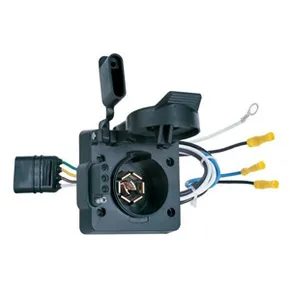
Here is where most DIYers stumble. Your trailer plug might not match your tow vehicle’s receptacle. If the shapes don’t align, you need an adapter. Without the right adapter, the systems can’t connect. If your tow vehicle has fewer wires than your trailer, some functions won’t work unless you modify the wiring.
But adapters aren’t enough for diagnostics. You also need the right wiring tester. Using a 4-way tester on a 7-way plug is useless. The pins won’t align. The circuits won’t complete. You’ll get false negatives or no reading at all.
Before you touch a single wire, verify your equipment matches the connector type. It seems obvious. It rarely is.
Next, we’ll look at how to use a wiring tester safely to make sure you don’t have any electrical problems with your trailer.
Diagnosing Trailer Light Failures
Your trailer is hitched. The engine is purring. But the tail lights? Dark. Silent. This isn’t just an annoyance. It’s a liability.
Start with the simplest culprit. Bulbs burn out. Check them first. If the glass is blackened or the filament is snapped, replace it. Simple.
If the bulbs are fresh, disconnect the trailer from the tow vehicle. Isolate the variables. Test the tow vehicle’s own lights. Turn signals. Brake lights. Reverse lights. If they don’t work, the issue is in your truck or SUV, not the trailer.
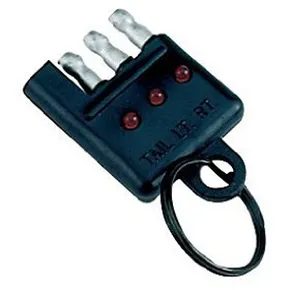
Assume your vehicle is fine. The next step requires a trailer wiring tester. Grab one. Make sure the adapter fits your socket. Many kits come with multiple heads for 4-pin, 7-pin, or even specific European standards. Don’t guess. Verify the fit.
Plug it in. Turn on the ignition. Hit the brakes. Activate the turn signal. The tester’s LEDs should flash in sequence.
If all lights respond, the problem is downstream. The trailer’s wiring harness is broken.
If the tester stays dark on a specific function, your vehicle’s wiring is the bottleneck. But what if the tester lights up when it shouldn’t? Say the left turn signal glows while you’re driving straight. That’s a short. Or a cross-connection.
Check the wiring in the tow vehicle. Look for bare wires touching. Look for wires spliced into the wrong terminals.
Fixing it depends on the damage. Misrouted wires? You can swap them with wire cutters, a stripper, and a crimper. It’s cheap. It’s fast.
Complex shorts? You might need a mechanic. Don’t risk it. Bad lights mean other drivers can’t read your intentions. That’s how accidents happen.
Preventing Future Corrosion
Once you’ve got the power flowing correctly, don’t just pack up and drive away.
Apply dielectric grease. Cover the tow vehicle’s socket. Coat the trailer’s plug.
Moisture is the enemy. It creeps into the pins. It causes corrosion. Corrosion increases resistance. Resistance kills conductivity. Eventually, the wires become useless.
Grease seals out the water. It keeps the connection clean. Do this every time you hitch up. It takes five seconds. It saves hours of troubleshooting later.
Resources for Towing Safety
For deeper dives into the mechanics behind these systems:
- How Batteries Work : Understand the power source.
- How Breakaway Kits Work : Know your emergency brakes.
- How Electricity Works : Basics of current and voltage.
- How Light Bulbs Work : Filament vs. LED.
- How Wires, Fuses and Connectors Work : Protecting the circuit.
External references on electricity and energy standards:
– U.S. Department of Energy, Energy Information Administration
Historical context and wiring diagrams:
– Allen, Mark. “What’s Going on Back There?” Popular Mechanics. Oct. 2006.
– Automotive Accessories Connection. “Trailer Wiring Diagrams.”
– Haystack Hill. “Trailer Wiring.”
– Sunrise RV. “Trailer Wiring.”