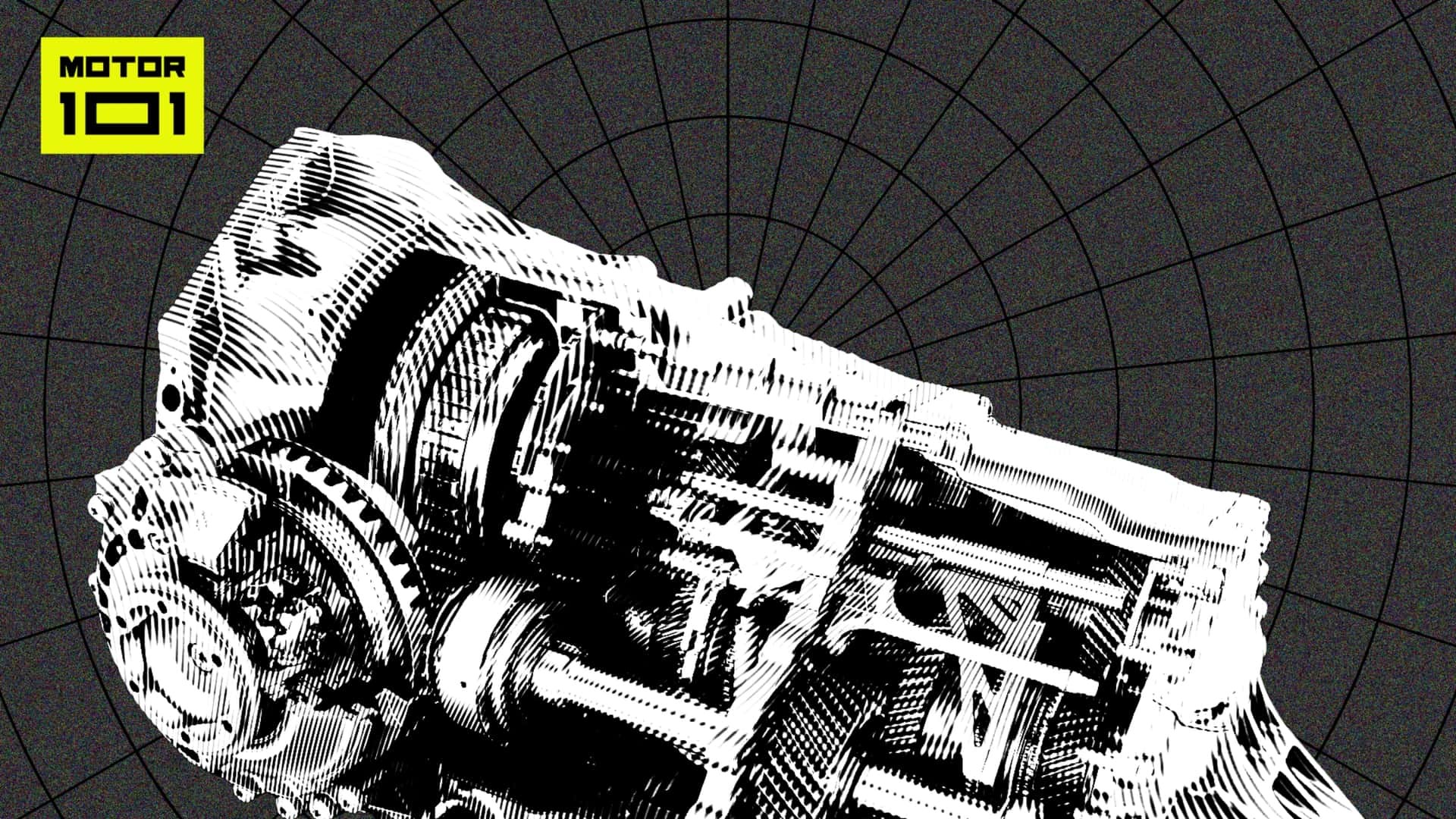
Automatic transmissions are everywhere. Yet they remain mechanically baffling to most.
Why?
Because they are the unsung heroes of modern driving.
Ever notice how your car doesn’t scream its head off while cruising at 80 mph, yet puts around town at 30 with ease?
A multi-gear transmission makes that possible. Enthusiasts love manuals, with their clutch pedals and hand-selected shifts, but most drivers surrender that control. We want the car to handle the work.
There are three main contenders: the Dual-Clutch (DCT), the Continuously Variable Transmission (CVT), and the old-school Automatic, which lacks a cooler nickname than “default.”
They all do the same job. They do it very differently.
The Traditional Automatic (Torque Converter)
Most people call this the automatic.
Sometimes they joke and call it a “slushbox,” a derisive label that suggests it’s full of goo. It is, technically, but that’s doing its complexity a disservice.
The heart of the system is the torque converter.
This isn’t a solid metal connection like in a manual. It’s fluid coupling.
An engine pump, called an impeller, flings transmission fluid into a turbine. That spinning fluid drives the transmission gears. It multiplies torque. It slips.
Planetary gearsets and hydraulic clutches handle the actual gear changes, all done behind your back. Modern units include a lock-up clutch, which eventually engages to stop that slipping once you hit cruising speed. It improves efficiency, but the core mechanism remains fluid-based.
The trade-off is comfort.
The big win is smoothness. And creep control. You stop at a light. You sit in gear. No stalling. No clutch burn. Just a gentle ease forward when the light turns green. It is undeniably easy.
The Dual-Clutch Transmission (DCT
The DCT is different.
It’s essentially a manual gearbox.
But it shifts itself.
And it does so fast.
Instead of a single clutch disc, there are two. One manages odd gears (1, 3, 5). The other handles even gears (2, 4, 6).
While you are in gear 2, gear 3 is already pre-selected on the other clutch. When you shift, you just swap clutches. No hunting for ratios. No lag. Just a crisp mechanical snap.
This makes DCTs the darling of performance cars. Porsche, VW, Hyundai—they all use them because the shifts are blistering.
But they have a flaw.
Low-speed traffic is tedious. The clutch engagement can feel jerky or abrupt. Creeping in congestion requires patience you didn’t need with the torque converter.
Is speed worth the traffic annoyance? For track enthusiasts, yes. For city commuters, maybe not.
The CVT
The CVT ignores gears entirely.
It doesn’t have them.
Instead, it uses a system of variable-diameter pulleys connected by belt or chain. One pulley expands while the other contracts. This changes the gear ratio continuously, offering an infinite range of ratios.
The goal is efficiency.
The engine stays at its ideal RPM for fuel economy while the car speeds up.
The result is smooth. Incredibly so.
But also weird.
The engine revs climb, stay flat, then drop. No distinct shifts. It feels like a drone.
Because drivers found that unsettling, manufacturers started simulating “fake” shifts to mimic the feel of traditional gears.
It’s the standard in hybrids and commuter cars, where mileage matters more than driving engagement.
The Takeaway
All three move power from engine to wheels.
The traditional automatic prioritizes comfort.
The DCT chases performance.
The CVT hunts efficiency.
You are probably using one of them right now without thinking twice about how the clutches engage or the fluid spins.
Which one do you prefer?