You are likely tired of hearing about the SUV boom. It is endless. Showrooms are stuffed. Gas prices are high, yet sales keep climbing. Manufacturers love this. Sport-utility vehicles yield higher profit margins than standard passenger cars. If you are a car company with no SUV to offer, you are watching from the sidelines with envy.
The automakers left out of this lucrative club have split into two camps. The first group—like BMW with the X5—paid the massive development costs to build a proper SUV. The second group? They just lifted their station wagons. They slapped on plastic cladding. They added all-wheel drive. They wrote press releases filled with the phrase “active lifestyle.”
Volvo joined the second camp. They didn’t invent the idea; Subaru’s Outback did. But Volvo’s V70 Cross Country (XC) arrived in 1997 and became an instant hit. By 1999, it made up 45 percent of all V70 sales. The marketing team loved it. So, they decided to update it. They wanted it to look less like a “wannabe” and more like a real SUV.
That meant more plastic.
A Meticulous Plastic Makeover
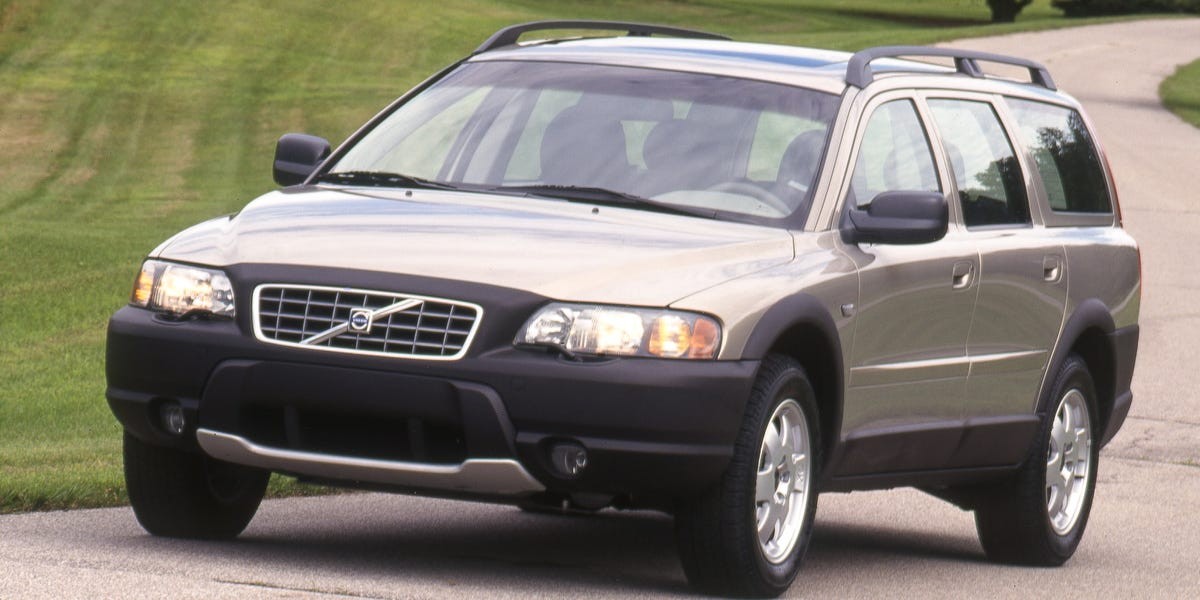
The first-generation V70 XC looked mostly like the regular V70. This second-generation model? It is aggressively dressed up. The designers used matte, scratch-resistant plastic for almost everything visible on the lower body.
The nose, minus the chrome grille, is wrapped in it. The rear bumper cover is too. A large air intake sits in the lower air dam, accented by what looks like a titanium skid plate. It is not titanium. It is plastic. The actual skid plate is credit-card-thin and requires you to crawl under the vehicle to see it.
The cladding runs along the lower doors and wraps around the wheel arches. It has an uneven texture that resembles dried lake mud. The color matches the body—dark brown or dark blue. Volvo claims this dark cladding protects the paint during “bushwhacking.” More importantly, it makes the car look taller. And it works.
Higher Ground, Wider Stance
It isn’t just smoke and mirrors. The ground clearance increased by one inch, landing at 8.2 inches. This matches the Audi Allroad 2.7 T Quattro and beats the base Ford Explorer (6.7 inches). Volvo engineers considered an adjustable suspension like Audi’s but scrapped the idea. The cost and complexity weren’t worth it for the marginally better capability.
To accommodate the ride height, the engineers fitted new 215/65HR16 tires. This required a slight widening. The wheelbase grew a quarter-inch to 108.8. The front track widened by 2.3 inches. Consequently, the front fenders flare out more.
Now you don’t need to read the badge to spot an XC. The wider track and flared fenders give it a planted, rugged presence that the standard on-road V70 lacks.
Interior Versatility First
Step inside, and the biggest change is in the rear. Volvo introduced an industry-first three-part 40/20/split rear seat. Fold any combination. Or unlatch the center seatback and flip it forward to become an armrest. You can even remove the center cushion entirely and swap it for a beverage cooler or a storage bag. The cooler plugs into a 12-volt rear outlet. Practical? Absolutely.
Up front, things are less dramatic. There is a titanium-colored grab handle along the right edge of the center console for the passenger to hold onto during rough terrain. Beyond that, it’s standard V70 fare. Plain. Functional. Not flashy.
The Price of “Adventure”
Here is where you might gulp. Our tester rang in at $42,867.
The base price starts at $35,475. The extras piled on quickly. A $2,500 navigation system. A $1,425 Leather and Versatility Package featuring baseball-glove stitching and a ceiling-mounted cargo grate. A $1,200 power sunroof. A $1,000 premium audio system with a four-disc CD changer. A $635 security package with laminated glass and motion detectors. Plus, a $400 Cold Weather Package.
The total cost put this wagon in the same price bracket as a Lexus RX300 or a Mercedes-Benz ML320. Does a lifted wagon with plastic fender flares warrant that premium?
Driving Dynamics: Not an SUV, But Faster
It is more fun to drive than most SUVs. All of them? Maybe.
Propelling the XC is Volvo’s 2.4-liter, five-cylinder turbo engine. It produces 197 horsepower. In our test, it hit 0-60 mph in 8.6 seconds. It was 0.9 seconds slower than the more powerful Audi Allroad but 1.2 seconds faster than the ML320. The five-speed Geartronic automatic transmission shifts smoothly. You can shift manually using the stalk, which is useful for engine braking on slippery downhill slopes.
The all-wheel-drive system is a proven torque-biasing unit. On dry pavement, it sends 95 percent of power to the front wheels. A viscous coupling sends power to the rear when slip is detected. Volvo adds TRACS, which applies brakes to a spinning wheel to shift power to the wheel with traction.
On dirt, the new Pirelli Scorpion tires and increased clearance make a difference. The knobby tread compromises razor-sharp handling on dry pavement. On the skidpad, it logged 0.77g. That is 0.03g below the sportier V70 T5 but better than many SUVs.
Safety and Utility
Like the T5, the XC comes loaded with safety tech: whiplash protection, side-impact airbags, and side-curtain airbags. Volvo also offers roof-rail accessories like bike racks and snowboard carriers. There is even a folding picnic table for two that mounts to the tailgate.
Despite the rugged posturing, the XC remains a comfortable Volvo. It is safe. It is practical. If you must choose between a traditional SUV and the V70 XC, the Volvo wins. If you can choose between wagons? The T5 is sharper. But if you need the extra clearance and the AWD, the XC delivers the SUV benefits without the SUV disadvantages.
Other Voices on the Cross Country
Patti Maki: Drove the T5 in July. It was fast. Sharp. Expensive. The XC feels ponderous in comparison. It has 50 fewer horses and 50 more pounds. The exterior styling is dumpy. The interior, with its dark brown leather and pull-down cargo cage, is nice. But the XC can’t match the T5’s speed.
Csaba Csere: Took my daughter to a carnival. The only parking was on a grassy shoulder. With a low sports car, I would have hesitated. With the XC? No worries. I didn’t worry about scraping the underbody or hitting the curb. It offers the clearance of an SUV with the driving feel of a wagon.
Larry Webster: Dressing up a wagon to look like an SUV works. Subaru proved it. Audi joined in. Volvo’s Cross Country makes the case too. It has four-wheel drive but keeps the silky ride of a two-wheel-drive Volvo. Living in Michigan, my front-wheel-drive car usually gets me everywhere. So for me? I’d still take the lighter T5. But I understand the appeal of the XC.