Buying a full motorcycle trailer makes sense if you are hauling two or three bikes. It also makes sense if you plan on taking the trailer out often enough that the maintenance cost gets amortized over time. But if you just want to bring one machine along for the weekend, the trailer is overkill. You don’t need another wheel to worry about. You don’t need to check tire pressure on a second axle. You just need to get the bike off the main road and into the campground or trailhead.
There are cheaper, simpler ways to move a motorcycle behind your rig.
The Hitch-Mounted Cradle
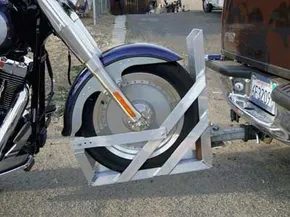
The most direct solution is a motorcycle towing cradle. People call these by a dozen different names. Motorcycle trailer hitch dollies. Receiver hitch caddies. Whatever you call it, the mechanics are simple.
“All you have to do is lock the front wheel into this contraption and, in some cases, further secure the bike with towing straps.”
These units bolt directly into the receiver tube of your vehicle’s hitch. A chock or cradle at the end holds the front fork. You don’t strap the whole bike down. You just lock the front wheel. The rear wheel rolls freely on the pavement. Some models include extra straps for stability. Most don’t. If you are doing 55 mph on the interstate, the bike will wobble a bit. It will track. You will need to drive smoothly.
This setup removes the need for a separate trailer. It also removes the need to load the bike with ramps. You just roll it up to the hitch and drop the front fork in. Done.
RV Lifts and Horizontal Mounts
If you are driving a Class A motorhome, space is tight. You might not want a bike rolling behind you in the wind. You might want it stowed away against the back of the vehicle.
RV motorcycle lifts solve this problem. They attach to the hitch and create a horizontal ledge. The bike sits flat. It is mounted parallel to the ground. This saves vertical space. It also keeps the bike closer to the vehicle’s center of gravity.
Straps and wheel chocks secure the bike to the platform. You can often fit one or two bikes this way. The horizontal orientation protects the mirrors and handlebars. They don’t flap in the slipstream.
Swivel and Fifth Wheel Trailers
Vertical mounting changes the physics. A swivel wheel motorcycle trailer, often called a fifth wheel setup, takes the ledge concept and extends it. The trailer arm reaches out from the hitch. A single wheel at the far end supports the weight. The bikes mount vertically.
This design eliminates jackknifing. The trailer is essentially an extension of your vehicle’s rear. It pivots with the hitch. You don’t have to worry about the trailer swinging out behind you like a traditional trailer might if you brake hard.
Vertical mounting is efficient. You can carry more bikes in less width. But you need to ensure the vehicle can handle the leverage. The longer the arm, the more torque on the hitch. Check your tow vehicle’s capacity. A light SUV might not like a third bike mounted on a long arm.
The Cost Factor
You can spend hundreds of dollars on a cradle. You might spend thousands on a full trailer. The cradle is the low-end option. It is also the low-maintenance option. No bearings to repack. No tires to replace. No lights to check.
“Motorcycle trailers are an excellent way to get out on the highway, without actually getting your bike’s motor running.”
If you just need to move a bike from point A to point B without turning the key, the cradle works. It is fast. It is cheap. It gets the job done. The trailer is better for comfort and stability. The lift is better for space. Choose based on what you are hauling. And how far you are going.
Related Articles
- How Loading and Unloading Towed Vehicles Works
- How Motorcycle Towing Safety Works
- How Motorcycles Work
- How Backing Up Towed Vehicles Works
- How Boat Towing Safety Works
- How to Brake While Towing
- How to Shift While Towing
- How to Turn While Towing
- How to Pass While Towing
- Motorcycle/ATV Towing Laws Quiz
More Great Links
- Motorcycle Trailer.com
- U-Haul
Sources
- California Department of Motor Vehicles. “Towing Your Trailer Safely.” 2007. (Oct. 22, 2008) http://www.dmv.ca.gov/pubs/dl648/dl648pt12.htm
- Fast Master Products. Oct. 17, 2008. (Oct. 22, 2008) http://www.cruiserlift.com/
- Hayes Trailer Sales. 2008. (Oct. 22, 2008) http://www.hayestrailersales.com/
- “The Little Known Pitfalls Of A Motorcycle Tow.” Custom Choppers Guide. 2008. (Oct. 22, 2008) http://www.custom-choppers-guide.com/motorcycle-tow.html
- MotorcycleTrailer.com. 2008. (Oct. 22, 2008) http://www.motorcycletrailer.com/
- Rocket Motorcycle Trailers. 2008. (Oct. 22, 2008) http://www.rocketmotorcycletrailers.com/
- Sports Utility Trailers. 2008. (Oct. 22, 2008) http://www.sportutilitytrailers