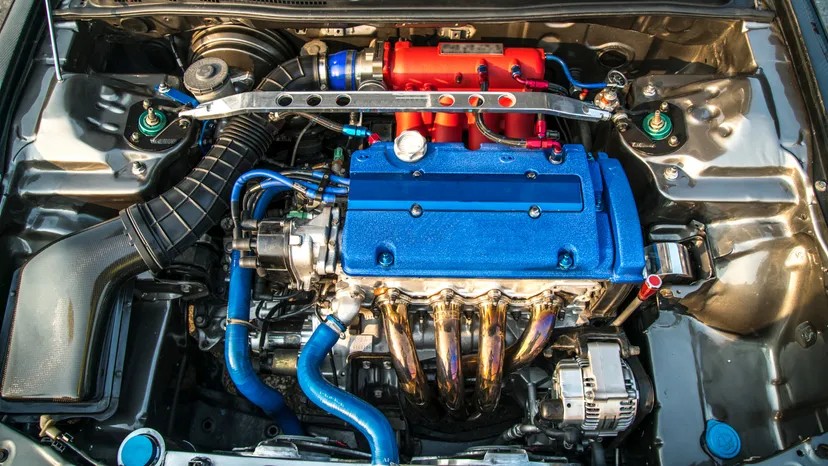
The intake system has only one role. Push as much of the mixture into the cylinder as possible. Engineers adjust the length of the pipe to facilitate this process. It works on the principle of pressure waves.
When the intake valve opens, air flows into the engine. It moves very fast. When the valve slams shut, the moving air hits the wall. It stops abruptly. Air collects and forms a high pressure area. This pressure wave travels upwards from the cylinder along the intake runner. It reaches the manifold. The wave bounces back down the pipe.
If the pipe length is correct, the waves will return when the valve is opened again. The extra pressure forces more mixture into the cylinder. It works like a small turbocharger.
This technique is very accurate. Too short or too long will fail. The benefits are narrow. Only works at certain RPMs. Pressure waves travel at the speed of sound. This speed varies with the density of the air. Temperature is also important. A good average velocity is 1300 feet per second (fps).
Let’s look at the math.
An engine running at 5000 rpm makes one revolution every 0.012 seconds. The intake valve opens every two revolutions. It stays open at about 250 degrees. This leaves an angle of 470 degrees between closing and opening. 5000 rpm takes 0.0156 seconds.
During this time, sound waves travel up to about 20 feet. The waves should rise and return. Therefore, the length of the runner should be half that. 10 feet.
Ten feet under the hood is out of the question. You can’t put that many pipes in the engine bay. The calculations revealed two problems. First, the area of influence is narrow. Changing the RPM to 3000 completely changes the required length. Second, 10 feet is too long.
The engineers solved the length problem by shortening the pipe. If the channel is 2.5 feet long, the wave will travel up and down four times before the valve opens. It still arrives at the right moment. The effect holds.
There are other techniques as well. When air moves quickly, turbulence is created. Turbulence enables better mixing of fuel and air. To increase speed, use smaller diameter runner. The same amount of air must pass through a smaller space. It speeds up.
However, there are drawbacks. Small pipes limit the flow. When driving at high speeds, the engine requires a large amount of air. A narrow pipe chokes it. Larger pipes allow flow but kill low-end velocity.
The manufacturer split the difference. It uses two intake ports for each cylinder. One is very small. One is big. A butterfly valve controls them. At low speeds, the valve closes the large pipe. The small pipe dominates. The torque increases. The valve opens at high rpm. Air flows along large channels. Top-end power increases.
The intake system has a balancing role. Pressure waves. Pipe lengths. Valve timing. Every detail is important.
Regulated air intakes offer optimal benefits in a very narrow speed range, but expanding their usefulness requires intelligent design.
You may be wondering which setting is best for daily driving or track use. The answer depends on where you drive. But the physics remains the same. Fast air. Pressure waves. Correct timing.