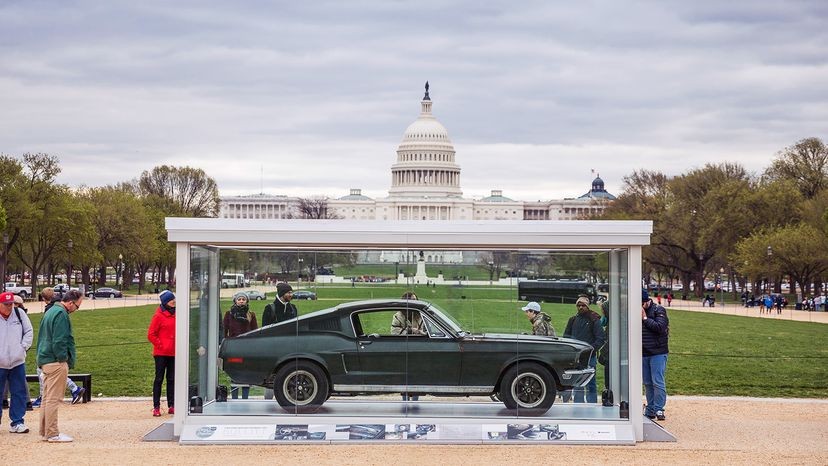
You probably think Steve McQueen’s green 1968 Ford Mustang Fastback has zero in common with the beige 1984 Plymouth Voyager. One is a muscle car icon. The other is the vehicle that accidentally invented the minivan category. Both are wrongfully ignored by most car enthusiasts.
They are both on the National Historic Vehicle Register.
It sounds obscure. That is because it is. Most people have never heard of it. The registry operates like the National Register of Historic Places, except it tracks metal and rubber instead of brick and mortar. It exists to preserve the stories of American automobiles that actually mattered.
The Historic Vehicle Association created this list. They are a government-backed agency. Their goal is simple: preserve and celebrate significant vehicles. They partnered with the U.S. Department of the Interior in 2013. The result was the National Historic Vehicle Register. It archives these cars within the Library of Congress. Right now, only 24 vehicles hold this title.
Cars at the Capital Exhibition
How do you see them? You have to go to Washington, D.C. every April.
That is when the Historic Vehicle Association hosts “Cars at the Capital.” They bring a rotation of these historic machines to the National Mall. It is the only time most of these cars leave private garages.
The 2018 lineup proves how wide the definition of “significant” can be. It wasn’t just fast cars. It was cultural touchstones.
- 1968 Ford Mustang Fastback: The exact car Steve McQueen drove in Bullitt.
- 1985 Ferrari Mondial Cabriolet (Modena Spyder): The yellow Ferrari from Ferris Bueller’s Day Off.
- 1927 Ford Model T: The car that put America on wheels.
- 1918 Cadillac U.S. 1257X: An early presidential or official transport vehicle.
- 1984 Plymouth Voyager: The very first unit. The genesis of the modern minivan.
Why is the first minivan on the same list as a Ferrari? Because it changed how people moved. It shifted the culture. The registry recognizes that impact just as much as horsepower.
Private Ownership and Public Access
Most of these cars are not in government museums. They are privately owned. This makes them hard to find.
Some sit in museums around the country. Others are in climate-controlled garages. Seeing them is entirely up to the owner. The registry website lists where each car is currently on public display. You have to check there before you drive to D.C.
“For most of us, the Cars at the Capital exhibition is the only way to get up close and personal with these automobile examples of American history.”
The barrier to entry is high. The access is low. But the list remains intact. It holds the Mustang. It holds the Voyager. They share a spot in history that most people never see.
The Filter for the National Historic Vehicle Register
There are only 24 cars on the National Historic Vehicle Register. That number feels small for a country obsessed with horsepower, but the bar to get in is punishing. You don’t just buy your way onto the list. The selection process is rigorous, designed to filter out mere collectibles and spotlight machines that shaped the nation.
To earn that spot, a vehicle needs an undeniable relationship to the history of the U.S. It has to tick at least one of four specific boxes:
- Historic Events: The car was present for something major in automotive or American history.
- Significant Figures: It belonged to someone who mattered in those same spheres.
- Design Excellence: It stands out for engineering, craftsmanship, or pure aesthetic value.
- Firsts, Lasts, or Rarity: It’s the first or last of its kind, a rare survivor, or so well-preserved it’s practically a time capsule.
Casey Maxon, a historian at the Historic Vehicle Association (HVA), notes that timing plays a role too. If a big anniversary or cultural moment is looming, the staff looks for cars that can drive public attention toward automotive history.
“Cars are chosen by our staff with input from a number of HVA advisers within academia, the museum and collector car community, as well as experts in restoration, preservation and conservation,” Maxon said.
The Library of Congress handles the actual archives. It’s a public resource, making the data accessible to anyone who knows where to look. But don’t assume that picking one car means the whole model year gets inducted. Ronald Reagan’s 1962 Willys “Jeep” CJ-6 is on the register. Your neighbor’s identical 1962 CJ-6 is not. Each vehicle is judged on its own individual story and condition.
The Cost of Documentation
Selecting the car is just the appetizer. The real work—the expensive, labor-intensive part—starts after the decision is made.
The HVA aims to document between five and ten vehicles annually. For each one, they follow guidelines similar to the Historic American Engineering Record. The output is exhaustive:
- Hyper-detailed photography: Every angle, every scratch.
- Written history: A report outlining provenance, complete with historic images.
- Scale drawings: Based on laser scan data for precision.
- Documentary film: A short video capturing the machine’s essence.
This documentation usually happens at the HVA’s National Laboratory. Sometimes, they travel to a location tied to the vehicle’s history. All of this costs money. The HVA relies on industry partners for funding and launches specific fundraising campaigns for high-profile projects.
Currently, the list is predominantly American. But there are exceptions for imports that left a mark on U.S. culture. You’ll find a 1938 Maserati, a 1954 Mercedes-Benz, and the iconic 1985 Ferrari Testarossa Spider from Ferris Bueller’s Day Off on the roster.
So, if you’re sitting on a garage full of vintage gems and wondering how to get them recognized, you’re out of luck. The National Historic Vehicle Register does not accept public submissions. You can’t apply. You can’t donate your way in.
“The Historic Vehicle Association has quite a network of people with various areas of expertise in the vintage and collector car worlds.”
Casey Maxon pointed out that the group keeps a backup database. It’s full of vehicles that meet the criteria but were passed over for some reason—maybe funding ran out, or maybe a more urgent candidate popped up. The list is static, but the interest remains. And for the gearheads waiting in the wings, the wait continues.