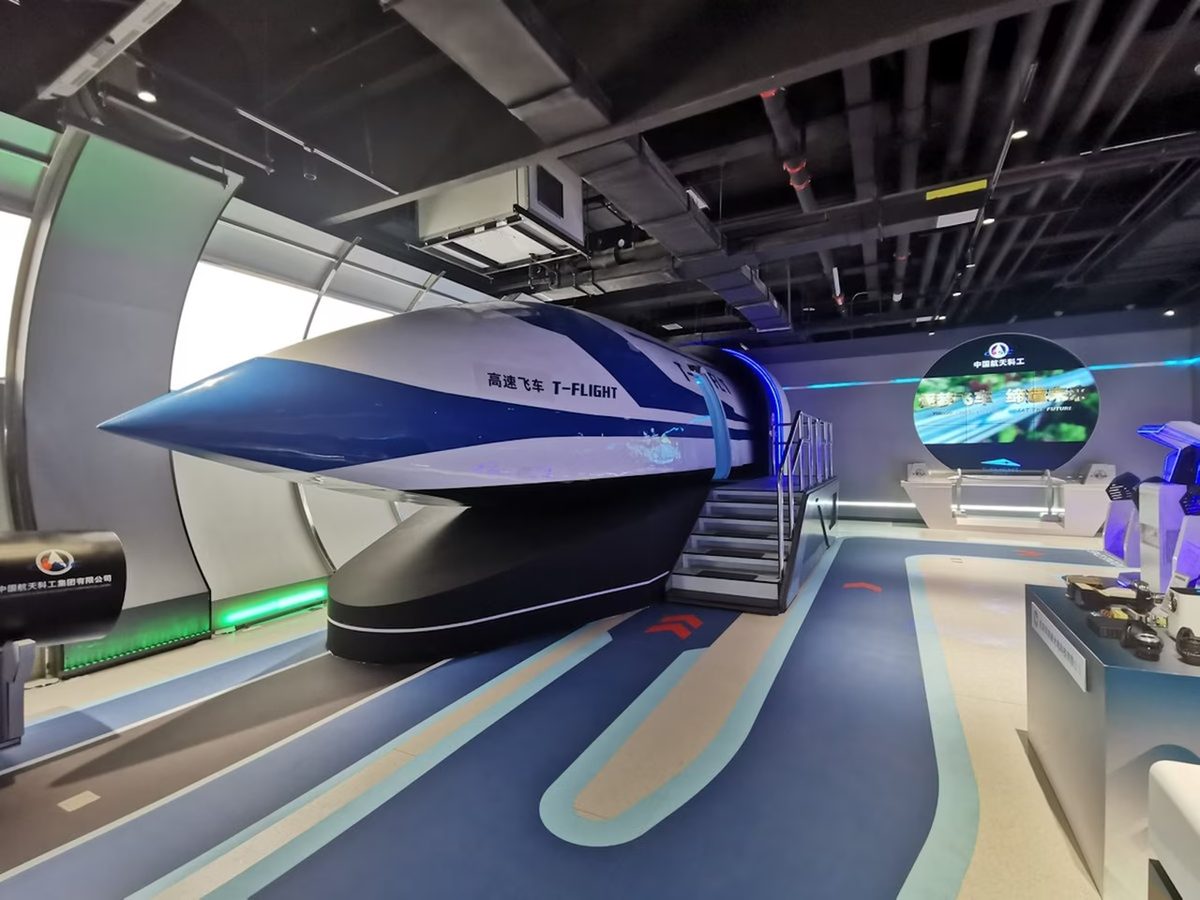
China invests heavily in vacuum tube transport. China Aerospace Science and Industry Corporation (CASIC) in cooperation with Shanxi Province is planning the development of T-Flight maglev train, which can reach a speed of 1000 kilometers per hour. We are not talking about theoretical physics here. This is a hardware project and the test track is already in the ground.
Previous 2 km tests showed that the system can actually handle 623 km/h. The data shows that suspension height and speed stability don’t just work on paper, but in the real world. This technology mirrors Elon Musk’s Hyperloop concept. It uses a low-pressure tube to eliminate air resistance. Musk’s project stalled. China is accelerating.
This country has the space, population and financial will to build infrastructure of this scale. Why build a 1,100 km line just to cut the travel time in half?
60 km trial course
The next phase isn’t a short loop. The 60-kilometer test section is under construction. Here, the T-Flight maglev train can reach 1,000 km/h, its first major commercial benchmark.
The ultimate goal is to put it into practical use. It connects Beijing and Shanghai in 90 minutes. This is a huge market. Currently, the high-speed train journey on this route takes about 4-5 hours. Cutting it in half would change the way people move around the country. We have changed business logistics. it changes everything.
Is 4,000 km/h Realistic?
航天科工六年前发布了一段视频,声称目标是4,000公里/小时 。 这就是高超音速地面运输。 同一个视频提到了 1,000 公里/小时的目标。 目前尚不清楚 4,000 公里/小时的数字是否仍在路线图上。
以这样的速度,工程风险是极大的。 真空管中的任何一个裂缝都会导致灾难性的减压。 乘客的安全几乎无法保证。 The G-forces alone would be brutal.
尽管如此,1000公里/小时的目标还是可以实现的。 4,000 公里/小时的梦想可能只是营销而已。 或者遥远的登月计划。 目前,重点是证明真空管能够以商业速度工作。 如果确实如此,世界其他地区将不得不迎头赶上。